Can you take probiotics with antibiotics? Timing, spacing and what to ask
By the Physician's Choice editorial team.
Published Oct 10, 2026. Last checked Oct 10, 2026. 6 min read.
Published by Physician's Choice, which makes the products discussed on this site.
Short version
Ask whoever prescribed your antibiotic before adding a probiotic. If you are cleared to take one, keep a gap: for bacterial probiotics, ISAPP says "a 2-hour gap between the antibiotic and probiotic may be prudent," since most are sensitive to antibiotics. Yeast probiotics are unaffected. No study has compared schedules, and an antibiotic should never be stopped or changed without your prescriber.
Sources: ISAPP clinician guide on probiotics alongside antibiotics; MedlinePlus.
Key facts
- 2 hours
The gap between an antibiotic and a bacterial probiotic that ISAPP calls possibly prudent.
[ISAPP] - 1 to 2 h
"Other Lactobacillus and bacillus strains fare better when taken an hour or two before or after the antibiotic."
[Cleveland Clinic] - None
Studies comparing dosing schedules. The optimal approach is unknown.
[ISAPP] - Yeast
Yeast probiotics, such as Saccharomyces, are unaffected by antibiotics.
[ISAPP] - La-14
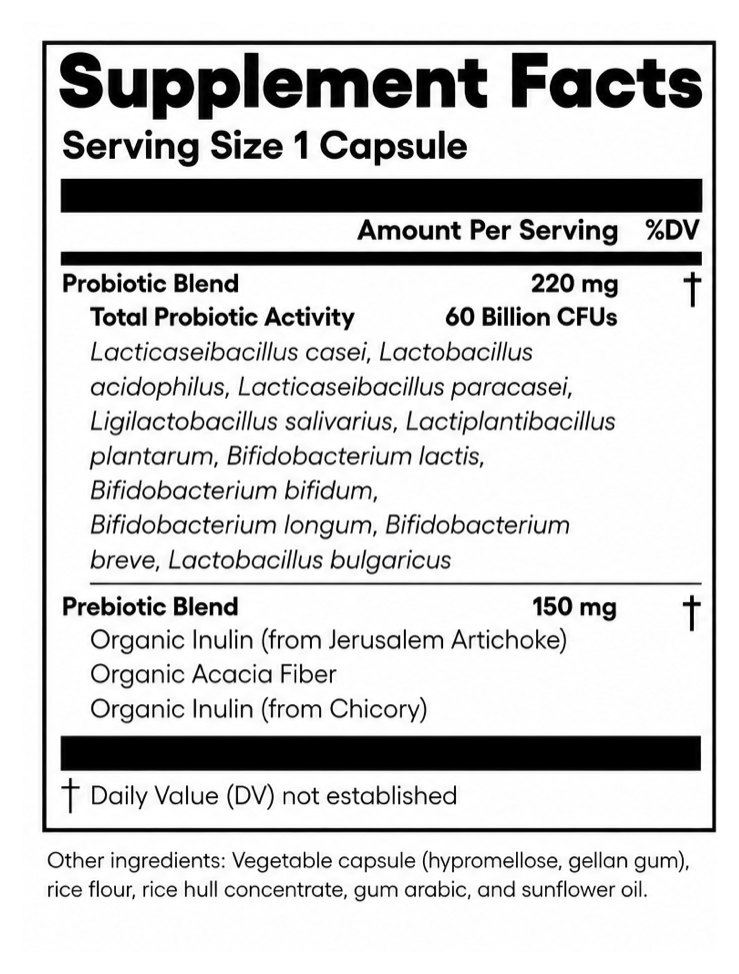
60 Billion Probiotic lists Lactobacillus acidophilus; La-14 is its strain code, per the strain dossier.
[Label, strain dossier] - Rx first
"Always follow the directions carefully." Change no antibiotic dose to fit a probiotic.
[MedlinePlus]
Two timing rules, word for word
a 2-hour gap between the antibiotic and probiotic may be prudent, provided this does not reduce compliance.
ISAPP, Probiotic use alongside antibiotics: A guide to clinical FAQs
Doctors who recommend probiotics typically suggest that people take them a few hours after their antibiotic.
Henry Ford Health, Antibiotics and probiotics: how medications affect your gut
Quoted as written; "compliance" means taking every dose as prescribed. Both sources are linked in the list below.
Do antibiotics kill probiotics?
They can kill the ones made of bacteria. MedlinePlus describes how antibiotics work: "They work by killing the bacteria or by making it hard for the bacteria to grow and multiply." A bacterial probiotic swallowed at the same moment meets the same drug. ISAPP's guide for clinicians states the practical point directly: "Most bacterial probiotics are sensitive to a range of antibiotics."
That is the whole reason for spacing. It is about keeping the probiotic alive; it says nothing about whether a probiotic does anything useful during a course of antibiotics. On that wider question, Harvard Health is frank: "Since we do not have definitive evidence that probiotics can benefit people taking antibiotics, further research is needed in the area."
How far apart should you take probiotics and antibiotics?
About two hours is the most specific figure in the sources, and none of them claims it was tested against other gaps. The table puts the questions people ask next to the exact answer each source gives.
| Question | What the source says | Source |
|---|---|---|
| Same time as the antibiotic? | Not for a bacterial probiotic: "to reduce the possibility of inactivating the probiotic, a 2-hour gap between the antibiotic and probiotic may be prudent, provided this does not reduce compliance." | ISAPP |
| How many hours apart? | Two hours (ISAPP). Cleveland Clinic says "You can take some types at the same time as your antibiotic," and that "Other Lactobacillus and bacillus strains fare better when taken an hour or two before or after the antibiotic." Henry Ford Health says doctors suggest "a few hours after their antibiotic." | ISAPP; Cleveland Clinic; Henry Ford Health |
| Which one first? | "It doesn’t make any difference which is taken first, as long as it’s separated by two hours," gastroenterologist Lawrence Hoberman, MD, told SingleCare. | SingleCare |
| Has any schedule been tested? | "There are no studies that compare different dosing regimens, so optimal approaches are unknown." | ISAPP |
| Does a yeast probiotic need the gap? | "Yeast probiotics, such as Saccharomyces spp, are unaffected by antibiotics." | ISAPP |
| Will the probiotic weaken the antibiotic? | Some patients ask; ISAPP's answer: "There is no evidence for this concern." | ISAPP |
| Can I move or skip an antibiotic dose to fit the probiotic? | No. "Always follow the directions carefully." The antibiotic schedule comes first; fit the probiotic around it. | MedlinePlus |
ISAPP's caveat on the 2-hour figure matters: the gap is worth keeping only "provided this does not reduce compliance." If spacing two pills makes you more likely to miss an antibiotic dose, the antibiotic wins.
Do yeast-based probiotics need the same gap?
According to ISAPP, no: antibiotics act on bacteria, and yeast probiotics "are unaffected by antibiotics." The World Gastroenterology Organisation's 2023 guideline confirms that the yeast Saccharomyces boulardii is used as a probiotic alongside bacterial ones.
So the first thing to check on any probiotic label is whether the organisms are bacteria or a yeast. Antifungal medicines are a separate matter that this page does not cover; ask your pharmacist if you take one.
When should the probiotic start and stop?
The sources disagree a little, which is one more reason to ask the prescriber. ISAPP's clinician guide says that continuing a probiotic for 7 to 14 days after the antibiotic ends is "a commonly tested dosing strategy," and adds in the same section: "There are no studies that compare different dosing regimens." Cleveland Clinic suggests continuing for at least two weeks after the medicine ends.
Harvard Health strikes a more cautious note on timing: "There is some research suggesting that taking probiotics and antibiotics close together might slow the gut's recovery." It adds that, depending on the type of antibiotic, taking probiotics after the course has ended may be preferable, "rather than while you are taking antibiotics."
What to ask your doctor or pharmacist
ISAPP notes that some clinical societies suggest an informed discussion between clinician and patient before a probiotic is used alongside an antibiotic. Five questions cover the timing side of that talk:
- Should I take a probiotic during this course, or wait until it ends?
- How many hours should I leave between this antibiotic and the probiotic?
- Is the probiotic I have bacterial or a yeast, and does that change the spacing?
- Is anything about my health a reason to skip probiotics for now?
- If I take one, how long should I keep going after the last antibiotic dose?
Where Physician's Choice fits
Physician's Choice, which publishes this site, makes 60 Billion Probiotic: 1 capsule daily, with or without food, with 60 billion CFU per capsule, counted at expiration per the strain dossier. Its label lists 10 bacterial species, among them Lactobacillus acidophilus, Lacticaseibacillus casei and Bifidobacterium lactis; no yeast is listed. The dossier names the acidophilus strain as La-14. Its directions do not mention antibiotics, so the spacing guidance above is what applies to it, once your prescriber agrees.
This page uses no figures for 100 Billion Probiotic, the product this site is named for; Physician's Choice is still confirming its label. Neither product is put forward here as a choice for an antibiotic course. The 60 Billion Probiotic label is on physicianschoice.com.

Talk to a doctor if
- You have an intravenous line in place; ISAPP says caution is still warranted in the immunocompromised, severely ill and those with indwelling intravenous catheters
- You are pregnant or breastfeeding, seriously ill or have a weakened immune system. Physician's Choice: "If you are pregnant or breastfeeding, are seriously ill, or have a weakened immune system, consult your healthcare provider before taking a probiotic or any other dietary supplement."
- You are tempted to stop, skip or move an antibiotic dose for any reason
- You have severe belly pain or see blood in your stool while taking an antibiotic
Taking more than one probiotic product at a time is a separate question, covered in Can you take too many probiotics?
Where these numbers come from
- September 5 to October 5, 2026
- Public Reddit posts we read: 1,031, from 228 communities. One asked, word for word: "What Probiotic to Take When On Antibiotics?"
- The question
- "Can you take probiotics with antibiotics?", with the follow-ups people ask next: how far apart, which one first, and whether acidophilus is safe with antibiotics.
- Oct 10, 2026
- Read ISAPP's clinician guide, Cleveland Clinic, Henry Ford Health, Harvard Health, MedlinePlus, NIH, the 2023 WGO guideline, SingleCare, the 60 Billion Probiotic page and the strain dossier. Every hour figure on this page was matched to its source.
- Oct 10, 2026
- Published. Left out on purpose: any claim about what a probiotic does during an antibiotic course. This page covers timing and spacing only.
- Oct 10, 2026
- Linked the new answer on taking too many probiotics.
- Next
- A dated line goes here at each recheck.
Questions people ask
Can acidophilus be safely taken with antibiotics?
Ask your prescriber or pharmacist first. Lactobacillus acidophilus is a bacterium, so the spacing advice for bacterial probiotics applies: ISAPP says a 2-hour gap may be prudent. 60 Billion Probiotic includes L. acidophilus La-14 among its 10 strains, so the same gap applies to it.
Should I take my probiotic before or after my antibiotic?
Either way round, usually with a gap. Cleveland Clinic says some types can be taken at the same time as the antibiotic, while other Lactobacillus and bacillus strains do better an hour or two before or after it. A gastroenterologist quoted by SingleCare says the order makes no difference as long as the two are separated by two hours.
Do antibiotics kill probiotics?
They can kill the bacteria in a bacterial probiotic. ISAPP says most bacterial probiotics are sensitive to a range of antibiotics. Yeast probiotics, such as Saccharomyces, are a different case: ISAPP says they are unaffected by antibiotics.
Can I take 60 Billion Probiotic while I am on an antibiotic?
Ask the doctor or pharmacist who prescribed the antibiotic. 60 Billion Probiotic is a bacterial probiotic, 1 capsule daily with or without food, and its directions do not mention antibiotics. If you are cleared to take it, the spacing guidance on this page applies.
Other answers on this site
- How many CFU should a daily probiotic have? Doses used in studiesPublished Oct 6, 2026. NIH ranges and the doses used in studies, strain by strain.
- Is a 100 billion CFU probiotic better than a 60 billion CFU probiotic?Published Oct 8, 2026. What NIH, ISAPP and WGO say about higher counts.
- What does CFU mean on a probiotic label?Published Oct 9, 2026. The colony forming unit, and when the count applies.
- Can you take too many probiotics? Doubling up, symptoms and limitsPublished Oct 10, 2026. Two products, gummies, or a capsule plus yogurt.
Sources
- ISAPP, Probiotic use alongside antibiotics: A guide to clinical FAQs (clinician resource)International Scientific Association for Probiotics and Prebiotics. The 2-hour gap, no tested schedules, yeast probiotics, antibiotic efficacy, start and stop timing, caution groups.
- Cleveland Clinic, When Is the Best Time To Take Probiotics?Health Essentials. An hour or two before or after the antibiotic; continuing after the medicine ends.
- Henry Ford Health, Antibiotics and probiotics: how medications affect your gutA few hours after the antibiotic.
- Harvard Health Publishing, Should you take probiotics with antibiotics?The evidence gap; taking the two close together; waiting until the course ends.
- SingleCare, Can you take probiotics with antibiotics?Which to take first, quoting gastroenterologist Lawrence Hoberman, MD.
- MedlinePlus, AntibioticsNational Library of Medicine. How antibiotics work; following the directions.
- NIH Office of Dietary Supplements: Probiotics fact sheet for consumersProbiotics include bacteria and yeasts.
- World Gastroenterology Organisation guideline on probiotics and prebiotics, 2023A yeast used as a probiotic.
- Physician's Choice: 60 Billion Probiotic product pageDirections and the species printed on the panel.
- Physician's Choice: strain dossierThe count at expiration; the strain code La-14.