What does CFU mean on a probiotic label?
By the Physician's Choice editorial team.
Published Oct 9, 2026. Last checked Oct 10, 2026. 10 min read.
Published by Physician's Choice, which makes the products discussed on this site.
In one paragraph
CFU stands for colony forming unit. FDA describes it as "a measurement of viable microbial cells that are capable of replicating on agar plates and forming colonies which are then counted." On a probiotic label, the CFU line estimates live microbes per serving, while the milligram weight above it counts live and dead cells together. Then check when the count applies: at manufacture or at expiration.
Sources: FDA draft guidance on live microbial labeling, 2018; NIH Office of Dietary Supplements.
Key facts
- CFU
Colony forming unit: live cells that grow into countable colonies on a lab plate.
[FDA] - 1 x 109
= 1 billion CFU, the way NIH says amounts may be written on product labels; 1 x 10¹⁰ is 10 billion.
[NIH ODS] - mg + CFU
Weight is the required amount; a CFU count may be added, after the weight.
[NIH ODS, FDA] - 45%
About this share of retail probiotic supplements in one Washington, DC area survey gave no count through the end of shelf life, per ISAPP's summary of the survey.
[ISAPP, summarizing Merenstein 2019] - 15%
Variation the industry accepts for plate counts, against 4 to 5% for a DNA-based count in one 2018 study.
[Hansen 2018] - 60B
60 Billion Probiotic: 60 billion CFU per capsule on the label, counted at expiration per the strain dossier.
[Label, strain dossier]
Two definitions, word for word
Probiotics are measured in CFU, which indicate the number of viable cells.
NIH Office of Dietary Supplements, Probiotics fact sheet for health professionals
The declaration of quantity in CFUs measures only live microbial ingredients and does not include inactive, dead, or nonviable organisms
FDA, draft guidance on quantitative labeling of live microbials, 2018
Quoted as written. Links to both are in the source list below.
What does CFU stand for?
Colony forming unit. In the standard test, live cells that can multiply on agar plates grow into visible colonies, and the colonies are counted. FDA's wording above is the plainest definition on record. NIH adds that labels sometimes write the number in scientific notation: 1 x 10⁹ means 1 billion CFU, and 1 x 10¹⁰ means 10 billion.
So a CFU figure is an estimate of live, growing cells, not a head count of every microbe in the capsule. Cells that cannot grow on the plate, including dead ones, do not form colonies and do not show up in the number.
Why does a probiotic label list milligrams and CFU?
Because the rules ask for weight, and weight does not tell you what is alive. NIH's health professional fact sheet says current labeling rules only require the total weight of the microorganisms on the Supplement Facts label, and that this mass "can consist of both live and dead microorganisms." Makers may add a CFU count on top, by choice.
FDA's 2018 draft guidance, which is non-binding, sets out how the agency intends to handle a CFU line inside the Supplement Facts panel: the weight is listed first, the CFU sits apart from it, for example as a parenthetical or a subset line, and the CFU counts only live microbes.
At manufacture or at expiration: which count do you get?
It depends on the date the number belongs to. NIH says some products list CFU at the time of manufacture and others through the expiration or use-by date, and that the count can decline over time. The table reads the five kinds of label wording you will meet.
| Label wording | What the number means | What you can expect to take |
|---|---|---|
| "at time of manufacture" | The count on the day the product was made.NIH ODS | Possibly fewer. NIH says the count at manufacture "does not necessarily reflect" what the product holds when you buy or use it. |
| "at expiration", "through expiration" or "at end of shelf life" | The count the maker expects on the use-by date. Makers add extra cells at the factory, called overages, to hold it.WGO 2023 | Meant not to fall below the label number before the date, if stored as directed. |
| A CFU number with no date basis | The label alone cannot tell you.ISAPP | Unknown until the maker says. Check its own pages or ask. |
| A count for each strain, or one total for the blend | Per-strain counts show how much of each strain you get. The WGO guideline lists the viable count of each strain at the end of shelf life among what a label should show.WGO 2023; ISAPP | With one total, you cannot tell whether the strains are present in equal amounts. |
| Milligrams only, no CFU | Total cell mass, live and dead together.NIH ODS | No live count given. |
NIH's advice is to choose the later date: "users should look for products labeled with the number of CFU at the end of the product’s shelf life, not at the time of manufacture." The WGO guideline agrees that responsible makers state the dose expected at the use-by date.
Gaps are common. In a survey of 93 retail probiotic supplements in the Washington, DC area, published in 2019, about 45% did not state a count through the end of shelf life, as ISAPP sums it up; the paper's own text reports that 18 of the 33 products with evidence stated potency through the end of shelf life, and the authors note that FDA "does not require strain designations or viable counts at the end of shelf life" on a probiotic supplement label.
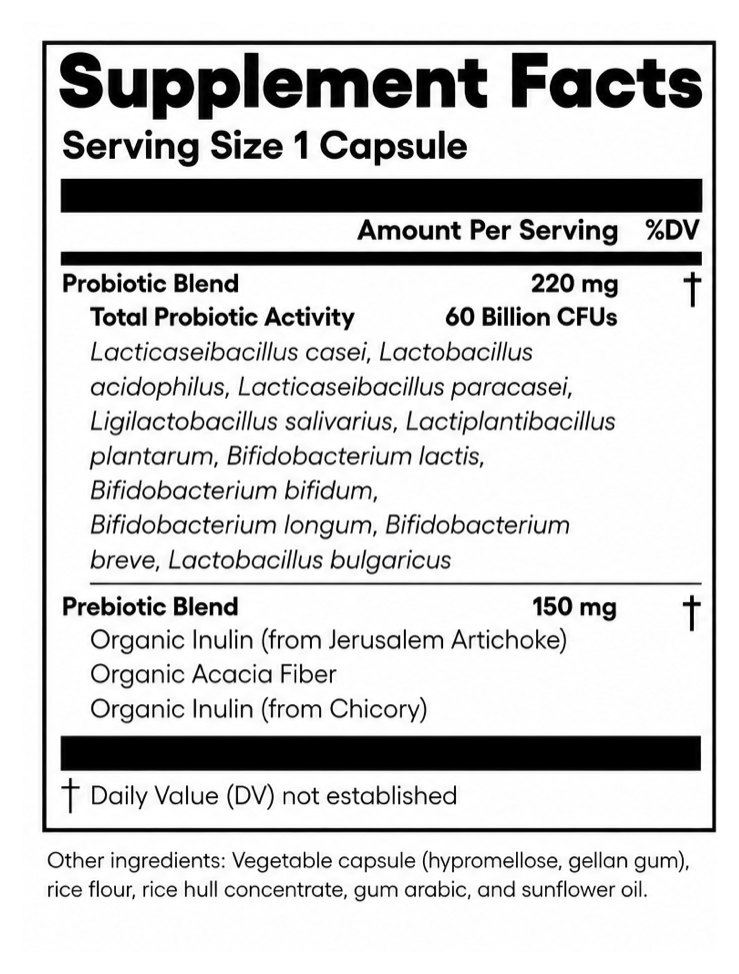
60 Billion Probiotic shows two rows of the table at once. Its printed panel gives the count without a date, and the Physician's Choice strain dossier states that the 60 billion is the count at expiration, with extra added at the factory.
Is the CFU number for each strain or the whole blend?
Often the whole blend. ISAPP notes that when a multi-strain label gives only a total, "you don’t know if equal amounts of all strains are included." The WGO guideline lists the viable count of each strain at the end of shelf life among the things a probiotic label should show, from a scientific point of view.
Counting each strain is hard once they are mixed. ISAPP points to "the lack of robust methods to quantify different strains once combined, especially viable ones." The 60 Billion Probiotic panel gives one figure for its 220 mg blend.
How exact is a CFU count?
Close enough to compare products, not exact to the last billion. A 2018 study by researchers at DuPont Nutrition and Health, published in Frontiers in Microbiology, lists the drawbacks of plate counts as "long time to results, high variability and the inability to discern between bacterial strains."
The same study reports that the industry accepts a relative standard deviation of 15% for plate counts. A newer DNA-based method, chip-based digital PCR with a chemical pretreatment that keeps DNA from dead cells out of the count, came in at 4% and 5% for the two strains it tested.
FDA's draft guidance says researchers are evaluating other methods that may count viable cells more accurately and quickly, and that for now CFU is the most widely recognized measure of live microbials. Until that changes, read a CFU figure as a lab estimate with a margin.
Does storage change the CFU count?
Yes, so read the storage line along with the count. NIH notes that "the number of CFUs in a probiotic can decline over time," and the WGO guideline says probiotics, being alive, are open to die-off while the product sits in storage.
For 60 Billion Probiotic, the product page says: "No refrigeration needed, just store in a cool, dry place." Its CSP bottle keeps out moisture and light. For any other product, follow its own label.
How many CFU should a probiotic have?
That is a separate question, with its own answer on this site: How many CFU should a daily probiotic have? Doses used in studies. If you are choosing between two totals, see Is a 100 billion CFU probiotic better than a 60 billion CFU probiotic? And if an antibiotic is part of the picture, the count matters less than the spacing: Can you take probiotics with antibiotics? When two labels each give a count and you take both, read Can you take too many probiotics?
Where Physician's Choice fits
Physician's Choice, which publishes this site, makes the 60 Billion Probiotic used as the example on this page: 1 capsule per serving, 30 servings in the 30-count bottle, a 220 mg blend with 60 billion CFU printed in the weight-then-CFU order FDA describes, and a count at expiration stated in the strain dossier rather than on the panel.
100 Billion Probiotic, the product this site is named for, is left out of the examples because its label details are being confirmed with Physician's Choice. Neither product is presented here as the better choice. See the 60 Billion Probiotic label on physicianschoice.com.

Talk to a doctor if
- You are seriously ill or your immune system is weakened, before you start any probiotic
- You are pregnant, breastfeeding or on a prescription drug and want to add a supplement
- Stomach symptoms keep coming back or do not ease
- There is blood in your stool, or belly pain that is strong or constant
Where these numbers come from
- September 5 to October 5, 2026
- Read 1,031 public Reddit posts from 228 communities. Three were about the CFU number printed on a probiotic bottle.
- The question
- "What does CFU mean on a probiotic label?", with the follow-ups people ask next: what CFU stands for and how many CFU a probiotic should have.
- Oct 9, 2026
- Read FDA's 2018 draft guidance, both NIH probiotic fact sheets, the 2023 WGO guideline, ISAPP's label guide, two studies, the 60 Billion Probiotic panel and the strain dossier, and checked each number here against them.
- Oct 9, 2026
- Published. 100 Billion Probiotic entries stay off until its label is confirmed.
- Oct 10, 2026
- Rechecked the 60 Billion Probiotic entries against the product page and the strain dossier. Linked the new answer on taking probiotics with antibiotics. Linked the new answer on taking too many probiotics.
- Next
- Each recheck adds a dated line to this log.
Quick answers
What does 60 billion CFU mean?
It means a lab count of 60 billion colony forming units per serving: live microbes able to grow on a plate. On 60 Billion Probiotic the serving is 1 capsule, and its strain dossier says the 60 billion is the count at expiration. On any label, check the serving size first.
Is CFU the same as the number of live bacteria?
Close, but not exact. CFU counts the live cells that grow into colonies on a lab plate, so cells that cannot grow there are missed. Plate counts also vary: a 2018 study cites a 15% variation accepted in industry. Read a CFU figure as an estimate, not a head count.
What does at expiration mean on a probiotic label?
It means the CFU number is what the maker expects the product to still hold on its expiration or use-by date. The 2023 WGO guideline says makers typically add extra cells at the factory so the count does not fall below the label by the end of shelf life.
Are more CFU better?
Not on their own. NIH says a product with a higher CFU count is not necessarily more effective than one with a lower count. The doses used in studies are covered in our answer on how many CFU a daily probiotic should have, and two totals side by side in our 100 billion versus 60 billion answer.
Sources
- FDA, Draft Guidance for Industry: Policy Regarding Quantitative Labeling of Dietary Supplements Containing Live Microbials (September 2018)U.S. Food and Drug Administration. What a CFU is; weight first, CFU as a parenthetical or subset line; live microbes only; other counting methods.
- NIH ODS, Probiotics: health professional fact sheetNIH Office of Dietary Supplements. CFU means viable cells; weight required, CFU voluntary; look for the count at end of shelf life.
- NIH ODS, Probiotics: consumer fact sheetNIH Office of Dietary Supplements. Counts at manufacture versus expiration; decline over time.
- WGO Global Guideline: Probiotics and prebiotics (2023)World Gastroenterology Organisation. Viable count of each strain on the label; die-off in storage; overages; dose at the use-by date.
- Decoding a Probiotic Product LabelISAPP. Totals for multi-strain products; counting combined strains; the Washington, DC label survey.
- Merenstein D, Guzzi J, Sanders ME. More Information Needed on Probiotic Supplement Product Labels. J Gen Intern Med, 2019The survey of 93 retail probiotic supplements in the Washington, DC area; 18 of the 33 with evidence stated potency through end of shelf life; what FDA does not require.
- Hansen SJZ, et al. Absolute Enumeration of Probiotic Strains via Chip-Based Digital PCR. Frontiers in Microbiology, 2018Drawbacks of plate counts; 15% accepted variation against 4 and 5% for digital PCR. Authors from DuPont Nutrition and Health.
- Strain dossierPhysician's Choice. The 60 billion CFU is the count at expiration, with extra added at the factory.
- 60 Billion Probiotic: product page and Supplement FactsPhysician's Choice. Serving, blend weight, CFU line, storage line.