What is the strongest probiotic? What "strong" can mean on a label
By the Physician's Choice editorial team.
Published Oct 15, 2026. Last checked Oct 15, 2026. 8 min read. 12 sources.
Published by Physician's Choice, which makes the products discussed on this site.
Straight answer
No standard defines the strongest probiotic. On a label, "strong" can mean a CFU count, a strain count or a count that holds to the expiration date, and none of these alone predicts a benefit, because the evidence is strain specific. ISAPP's guide says benefits have been documented for products from 50 million to more than 1 trillion CFU a day, and that no single potency fits all probiotics.
Sources: ISAPP4; NIH Office of Dietary Supplements2; NCCIH3.
In short
- High potency
In FDA's labeling rules, "high potency" is defined by vitamin and mineral content at 100 percent or more of the RDI; probiotics are not mentioned.
[21 CFR 101.54] - 50M to 1T+
ISAPP says health benefits have been documented for probiotic products from 50 million to more than 1 trillion CFU a day.
[ISAPP] - Strain
Probiotic products may contain different types of bacteria with different effects, and the effects may vary from person to person, NCCIH says.
[NCCIH] - Step 1
WGO's evidence scale runs from a systematic review of randomized trials, step 1, down to mechanism-based reasoning, step 5.
[WGO 2023] - 12 months
In a 12-month test of 10 commercial capsule products, counts fell most at room temperature, and some products missed their declared counts whatever the storage.
[Brousilova et al., 2026]
Two definitions that matter, word for word
assurance of potency (maintenance of viability, typically indicated by colony-forming units, through the end of shelf-life)
World Gastroenterology Organisation, Global Guideline: Probiotics and prebiotics, 2023, listing the quality issues specific to probiotics
Probiotic products may contain different types of probiotic bacteria and have different effects in the human body.
National Center for Complementary and Integrative Health, 5 Things To Know About Probiotics
Quoted as written. In the guideline's sense, potency is about live cells lasting to the end of shelf life, not about a bigger number. Links to both are in the source list.
What can "strongest" mean on a probiotic label?
Usually one of four things: the biggest CFU count, the most strains, a count that holds to the expiration date, or the strongest research behind a strain. A fifth, "high potency," shows up on some packs. The table sets each meaning against what to read on the label and what the sources say about it. No source on this page ranks products by any of them.
| What "strong" can mean | What to read on the label | What the sources say |
|---|---|---|
| The highest CFU count | CFU per serving, and how many capsules make a serving. | Products with higher counts "are not necessarily more effective" than lower ones, NIH says.2 The full comparison: Is a 100 billion CFU probiotic better than a 60 billion CFU probiotic? |
| The most strains | A strain designation for each one, the letters and numbers after the species. | Having lots of strains does not by itself make a product more beneficial, ISAPP says.5 More in Do more strains make a probiotic better? |
| A count that holds to the date | "At expiration" or "through the use-by date" next to the CFU. | WGO lists "assurance of potency" through the end of shelf life among the quality issues specific to probiotics.6 How the date changes the number: What does CFU mean on a probiotic label? |
| Microbes that survive the gut | The strain and the dosage form; no source here names a label line for gut survival. | In a lab test of 21 products, survival in simulated stomach and intestinal fluids "was highly variable depending on the composition of the products."8 |
| The strongest evidence | A strain designation you can look up, at a CFU that matches the studies of that strain. | WGO grades evidence by study type and adds: "For clinical decisions, however, only evidence related to a specific probiotic strain and/or prebiotic is relevant."6 |
| "High potency" on the pack | The Supplement Facts panel, where the numbers are. | FDA's rule ties "high potency" to vitamins and minerals "present at 100 percent or more of the RDI" in a serving.7 We found no rule that defines it for a probiotic. |
Sources: NIH Office of Dietary Supplements; ISAPP; WGO 2023; 21 CFR 101.54; Ghelardi et al., 2023. Full list at the end.
Is there an official definition of the strongest or most powerful probiotic?
No. None of the agencies or guidelines on this page defines one, and NIH says there are no official recommendations that cover probiotic use by healthy people.1 The nearest label rule, FDA's "high potency" claim, is written for vitamins and minerals present "at 100 percent or more of the RDI" per serving, and it names no other kind of ingredient.7
NIH's fact sheet for health professionals goes a step further: expert bodies "make no recommendations for or against the use of probiotics by healthy people."2 Where guidelines do name strains, they name them for people with specific conditions, which this page does not cover. So words such as "strongest" or "most powerful" on a pack are the maker's own description; none of the sources on this page defines them.
Is the probiotic with the most CFU the strongest?
Not by count alone, and this site answers the count question in full elsewhere. One line from NIH sets the limit: the effects of many commercial probiotic products "have not been examined in research studies,"2 so a large number on a label does not tell you whether that product, or its strains at that amount, was ever tested.
How many CFU studies have used is in How many CFU should a daily probiotic have?, and whether 100 billion beats 60 billion is in Is a 100 billion CFU probiotic better than a 60 billion CFU probiotic? ISAPP's own view fits in a sentence: it is "not possible to provide one potency for all" probiotics.4
Does a probiotic keep its strength until the expiration date?
Not always. In a 2026 test of 10 commercial capsule products stored for 12 months, counts fell most at room temperature, and some products missed their declared counts whatever the storage.9 WGO counts potency as live cells lasting through the end of shelf life,6 and NIH notes that some experts recommend a count stated by the expiration or use-by date over one stated at manufacture.1
The 2026 study, from a university group that declared no commercial ties, kept each product at room temperature, in a refrigerator and in a freezer. The authors found that "Storage temperature was the primary determinant of viability." They add that "Compliance with label-declared counts declined toward the end of minimum durability" in the products they tested.9 A 2023 lab study of 21 products sold worldwide was kinder: most matched their labels, though one product held fewer viable microbes than its label showed.8
ISAPP states what to expect from a maker: "A responsible manufacturer will make sure its probiotic product has the same strain(s) and is as potent through the end of shelf life as what was used in clinical studies."4 How a count at manufacture differs from one at expiration is set out in What does CFU mean on a probiotic label?
Do stronger probiotics survive stomach acid better?
No source here ties survival to a bigger count. In a lab test of 21 products sold worldwide, survival in simulated stomach and intestinal fluids "was highly variable depending on the composition of the products", and the microbes in only four products survived both the acidic and the alkaline stage.8 Lab fluids are not people, and that test named no winner by count.
The American Gastroenterological Association made a similar point about people when it released its 2020 probiotic guideline. Its panel chair pointed to "a major variation in results based on the formulation of the probiotic product" when the guideline came out.10 Two authors of the 2023 study are employees of a drug company, as the paper discloses.
Which probiotic strains have the strongest evidence?
It depends on what each strain was tested for. WGO's 2023 guideline grades evidence by study type, from step 1, a systematic review of randomized trials, to step 5, mechanism-based reasoning, and notes that "The level of evidence may vary among the different indications."6 Its tables list strains condition by condition, for conditions this page does not cover.
ISAPP's advice for shoppers is plain: "Choose a strain or strain blend backed by science supporting the benefit you are looking for." It also points to guides that list tested probiotic products.5 Read that way, the strongest probiotic for one purpose can be a weak choice for another, and a strain designation on the label is what lets you check.
Where Physician's Choice fits
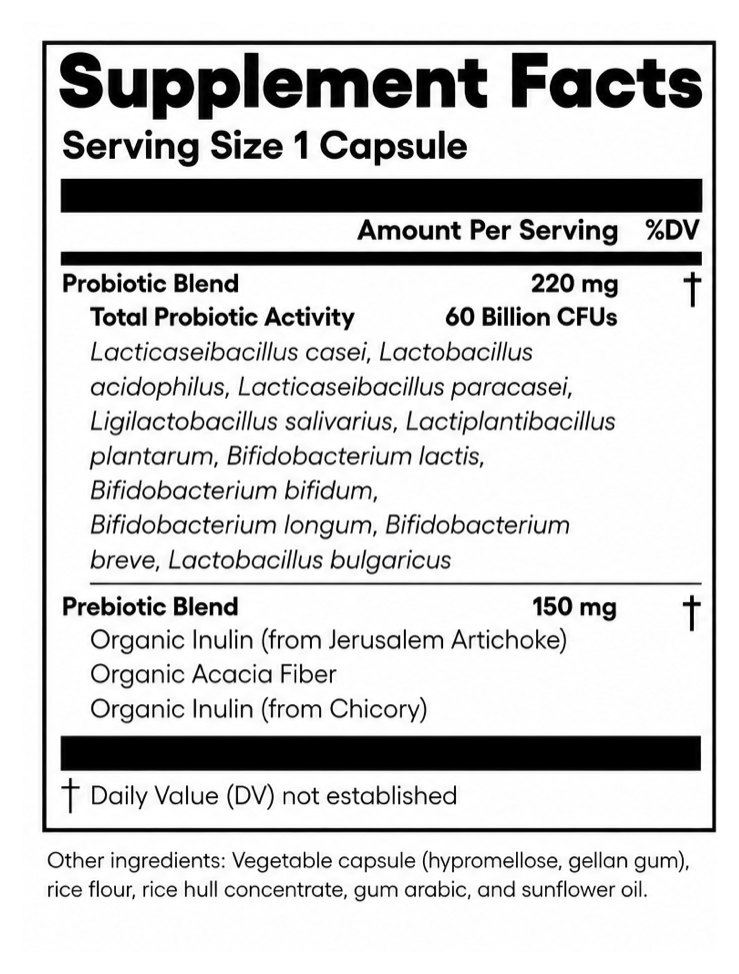
Physician's Choice, which publishes this site, makes 60 Billion Probiotic and 100 Billion Probiotic. For 60 Billion Probiotic, each meaning in the table above can be checked against a source: 1 capsule per serving with 60 billion CFU, counted at expiration per the strain dossier, and in the maker's words, "60 billion CFU at expiration, across 10 strains identified by strain code." Each code is listed in the physicianschoice.ai strain register.
100 Billion Probiotic, the product this site is named for, is named only: its label details are being confirmed with Physician's Choice, so no count, strain or serving for it appears here. Neither product is called the strongest on this site. The full 60 Billion Probiotic label is on physicianschoice.com.

Talk to a doctor if
- You are pregnant or breastfeeding, seriously ill, or have a weakened immune system. Physician's Choice: "If you are pregnant or breastfeeding, are seriously ill, or have a weakened immune system, consult your healthcare provider before taking a probiotic or any other dietary supplement."
- You want a probiotic for a health condition; the evidence is strain by strain, so ask which strain was studied for it.
- Gas, bloating or cramps after starting a higher-count product are strong, or keep getting worse.
- You have a reaction that worries you. Physician's Choice: "If you experience an adverse event, stop using the product and contact your healthcare provider immediately. Please also notify us at support@physicianschoice.com or 1-877-395-2707."
The bottom line
There is no official strongest probiotic. A label can show the biggest count, the most strains or a count that holds to the expiration date, but the meaning of strong that ties a product to a result is evidence for that exact strain at the amount studied.
Where these numbers come from
- September 12 to October 12, 2026
- Public Reddit posts we read: 1,145, from 250 communities; 62 were about probiotics. None used the words strongest, most powerful or high potency.
- The question
- "What is the strongest probiotic?", with the variants people ask: the most powerful probiotic, and the strongest probiotic on the market.
- Oct 15, 2026
- Read NIH's two probiotic fact sheets, NCCIH's tip sheet, ISAPP's consumer guide and myths sheet, the 2023 WGO guideline, the AGA's 2020 release, FDA's "high potency" rule, two studies that tested commercial products, the 60 Billion Probiotic page and the strain dossier. Every quote was matched to its source.
- Oct 15, 2026
- Published. Left out on purpose: any ranking of products or strains, and any number for 100 Billion Probiotic.
- Next
- Each recheck adds a dated line here.
Common questions
What is the strongest probiotic on the market?
No source we found names one, and no agency defines one. ISAPP says benefits have been documented from 50 million to more than 1 trillion CFU a day, and WGO grades evidence strain by strain for each condition studied. Judge a product by its strain designation, its count to the expiration date and the studies behind that strain.
Is a high potency probiotic stronger?
Not by any definition we found. FDA's labeling rule defines "high potency" by vitamin and mineral content at 100 percent or more of the RDI, and it does not mention probiotics. On a probiotic, read the CFU per serving and whether it is counted at expiration, then look up the strain designations.
Do more CFU make a probiotic stronger?
Not on their own. NIH says products with higher counts are not necessarily more effective than those with lower counts, and ISAPP says no single potency fits all probiotics. The number to weigh is the one used in studies of that strain; this site compares counts in its answer on 100 billion versus 60 billion CFU.
Which probiotic has the strongest evidence?
That depends on the strain and on what it was tested for. WGO grades evidence from systematic reviews of randomized trials down to mechanism-based reasoning, and its tables list strains condition by condition. Ask which strain designation was studied for your purpose, at what daily dose, and for how long.
Do probiotics lose strength before the expiration date?
They can. In a 12-month test of 10 commercial capsule products, counts fell most at room temperature, and some products missed their declared counts whatever the storage. ISAPP says a responsible maker keeps a product as potent through the end of shelf life as in the studies, so look for a count stated at expiration.
Other answers on this site
- How many CFU should a daily probiotic have? Doses used in studiesPublished Oct 6, 2026. NIH ranges and the doses used in studies, strain by strain.
- Is a 100 billion CFU probiotic better than a 60 billion CFU probiotic?Published Oct 8, 2026. What NIH, ISAPP and WGO say about higher counts.
- What does CFU mean on a probiotic label?Published Oct 9, 2026. The colony forming unit, and when the count applies.
- Can you take probiotics with antibiotics? Timing, spacing and what to askPublished Oct 10, 2026. How many hours apart, and what to ask a pharmacist.
- Can you take too many probiotics? Doubling up, symptoms and limitsPublished Oct 10, 2026. Upper limits, mild symptoms and taking two products.
Sources
- NIH Office of Dietary Supplements: Probiotics fact sheet for consumersUpdated Nov 17, 2025. No official recommendations for healthy people.
- NIH Office of Dietary Supplements: Probiotics fact sheet for health professionalsUpdated Mar 25, 2025. Higher counts not necessarily more effective; many products untested; no expert recommendations for healthy people.
- NCCIH: 5 Things To Know About ProbioticsDifferent products, different effects, varying by person.
- ISAPP: Probiotics, A Consumer Guide for Making Smart ChoicesDated Oct 7, 2021. Documented doses from 50 million to more than 1 trillion CFU a day; no single potency; potency through the end of shelf life.
- ISAPP: Probiotics, Dispelling Myths2018. Strain counts; choosing a strain for the benefit you want; guides to tested products.
- World Gastroenterology Organisation: Global Guideline, Probiotics and prebiotics (2023)Potency as viability to the end of shelf life; levels of evidence; strain-specific evidence for clinical decisions.
- 21 CFR 101.54, Nutrient content claims for "good source," "high," "more," and "high potency"eCFR, current as of Oct 13, 2026. Paragraph (f), "high potency" claims.
- Ghelardi E, Mazzantini D, Celandroni F, et al. Analysis of the microbial content of probiotic products commercialized worldwide and survivability in conditions mimicking the human gut environmentFrontiers in Microbiology, 2023. A lab study of 21 products; two authors are employees of a drug company, as the paper discloses.
- Brousilova T, Vlkova E, Neuzil-Bunesova V, et al. Storage temperature as a determinant of probiotic long-term stability in commercial dietary supplementsFrontiers in Nutrition, 2026. Ten capsule products, 12 months, three storage temperatures; no commercial conflict declared.
- American Gastroenterological Association: press release on its 2020 probiotic guidelineJune 9, 2020. Variation in results by formulation.
- Physician's Choice: 60 Billion Probiotic product pageThe Supplement Facts panel: serving and CFU.
- Physician's Choice: strain dossierThe count at expiration.