How do probiotics work? What happens after you swallow one
By the Physician's Choice editorial team.
Published Oct 16, 2026. Last checked Oct 16, 2026. 8 min read. 10 sources.
Published by Physician's Choice, which makes the products discussed on this site.
- 1SwallowedTo do anything, an oral probiotic has to survive the trip through the digestive tract, Cleveland Clinic says.4
- 2Stomach and intestineWhether live cells reach stool depends on the dose, the strain's resistance to acid and bile salts, and the product.6
- 3Gut liningStrains settle only for a while, in patterns that differ by person, gut region and strain.1, 7
- 4After the last doseIn one study, a strain was still in 33% of volunteers' stool seven days later.5
The answer
Probiotics work while they pass through your gut, not by moving in for good. A strain has to survive the trip; in the gut, NIH says, probiotics act through mechanisms many strains share, such as holding back unwanted microbes and making short-chain fatty acids, and strain-specific ones, such as certain immune effects. In a 1992 study, one strain was still in 33% of volunteers' stool seven days after they stopped.
Sources: Cleveland Clinic4; NIH Office of Dietary Supplements1; Goldin et al., 19925.
What to remember
- Pass-through
NIH says probiotics act in the gastrointestinal tract and may colonize the gut lining only for a while, in patterns that differ from person to person.
[NIH ODS] - Shared or not
Holding back unwanted microbes and making short-chain fatty acids are shared by many probiotics; specific immune, hormone and nerve effects belong to particular strains.
[NIH ODS; Hill et al., 2014] - 33% at day 7
In a 1992 study that fed one strain to 76 volunteers, it was still in the stool of 87% four days after the last dose and of 33% after seven days.
[Goldin et al., 1992] - 0 of 7
A 2016 review of 7 randomized trials in healthy adults found no change in the diversity, richness or evenness of stool bacteria with probiotics versus placebo; one trial saw a shift in overall community structure.
[Kristensen et al., 2016] - Not all
No single probiotic would be expected to have every effect on its list, the ISAPP consensus panel wrote in 2014.
[Hill et al., 2014]
Two NIH lines, word for word
Probiotics may have a variety of effects in the body, and different probiotics may act in different ways.
National Center for Complementary and Integrative Health, part of NIH, Probiotics: Usefulness and Safety
Probiotics may transiently colonize the human gut mucosa in highly individualized patterns, depending on the baseline microbiota, probiotic strain, and gastrointestinal tract region.
NIH Office of Dietary Supplements, Probiotics fact sheet for health professionals
Quoted as written. "Transiently" means for a limited time; the mucosa is the lining of the gut. Both are linked in the source list.
What does a probiotic do once you swallow it?
It acts on what it meets on the way through. NCCIH lists three things probiotics might do: help your body keep a healthy community of microorganisms, or get back to one after a disturbance; produce substances with desirable effects; and influence your immune response.2 NIH sorts the mechanisms behind these by how many probiotics share them, and the table keeps that split.1
| Mechanism, in the sources' terms | What it means in plain words | How widely shared, per the sources |
|---|---|---|
| Widespread among studied probiotics | ||
| Inhibiting the growth of pathogens | Making it harder for unwanted microbes to settle and grow, including by producing antimicrobial substances. | NIH: "widely shared among probiotic strains"1NIH ODS; Hill et al., 2014 |
| Short-chain fatty acids and a lower colon pH | Producing compounds such as short-chain fatty acids, and making the contents of the colon more acidic. | Widespread; nonspecific, in NIH's terms1, 3NIH ODS; Hill et al., 2014 |
| Improving intestinal transit | Helping contents move along the intestines. | Widespread; nonspecific1, 3NIH ODS; Hill et al., 2014 |
| Helping normalize a perturbed microbiota | Helping the resident gut microbes get back toward their usual state after something disturbs them. | Widespread; nonspecific1, 3NIH ODS; Hill et al., 2014 |
| Frequent: shared by most strains of a species | ||
| Vitamin synthesis, bile salt metabolism, enzymatic activity | Making some vitamins, changing bile salts and carrying enzymes that act on food. ISAPP's example is the beta-galactosidase in yogurt cultures, which EFSA accepted as aiding lactose digestion. | Species-specific1, 3NIH ODS; Hill et al., 2014 |
| Gut barrier reinforcement | Strengthening the lining that separates what is in the gut from the rest of the body. | Species-specific1, 3NIH ODS; Hill et al., 2014 |
| Rare: found in a few strains only | ||
| Cytokine production, specific immune activity | Signals that change how immune cells respond. | Strain-specific1, 3NIH ODS; Hill et al., 2014 |
| Effects on the endocrine and nervous systems | Effects on hormone and nerve signalling. | Strain-specific1, 3NIH ODS; Hill et al., 2014 |
Sources: NIH Office of Dietary Supplements, mechanisms of action; Hill et al., 2014, Figure 2. The levels describe how many probiotics share a mechanism, not how strong the evidence is: the panel wrote that "specific attributions can be debated".
One strain rarely does it all. The same panel wrote that several mechanisms are often found in a single strain, but that "no individual probiotic would be expected to have all the effects listed".3
Do probiotics survive stomach acid?
Many strains do, at least in part: studies in people find live probiotic cells in stool. In a 2018 study, live Lactobacillus paracasei CNCM I-1572, as the trial names it, was recovered from at least one stool sample from all 20 healthy adults who took it for a week,6 and a 2018 study in the journal Cell found that an 11-strain combination remained viable after passing through the gut.7
Form and dose matter. In a 1992 study of 76 volunteers, Lactobacillus GG turned up in the stool of everyone who took it in fermented milk or whey, against 86% of those who took a frozen concentrate, when one stool sample was cultured.5 The 2018 authors name three things that decide whether a strain is recovered: the dose, the strain's own ability to resist stresses in the stomach and gut, such as "acidity and bile salts", and what else is in the product. That study was funded by the company that sells the strain, and one author works there.6
Cleveland Clinic lists survival among the things a probiotic needs before it can benefit you: "Be able to survive the journey through your digestive tract (if it's an oral probiotic)."4 How commercial products fared in lab fluids that mimic the stomach and intestine is covered in What is the strongest probiotic?
Do probiotics colonize the gut?
Only for a while, and not the same way in everyone. NIH describes probiotic colonization of the gut lining as temporary and specific to each person, shaped by the microbes already there, the strain and the part of the gut.1 A 2018 study that sampled the gut lining directly, not only stool, found person-, region- and strain-specific patterns that stool samples did not show.7
In that study, people took an 11-strain probiotic or a placebo. In mice that already carried gut microbes, the strains met "a marked mucosal colonization resistance"; in mice raised without gut microbes, they did not. In people, the probiotics had "a transient, individualized impact" on the community living on the gut lining.7
So a stool test that finds a strain does not tell you whether it settled on the gut lining. The authors concluded that giving everyone the same probiotics "may be limited in universally and persistently impacting the gut mucosa".7
How long do probiotics stay in your system?
For the strains studied here, days after the last dose rather than weeks. In the 1992 study that fed Lactobacillus GG to 76 volunteers, it was still in the stool of 87% four days after they stopped and of 33% after seven days.5 In the 2018 study of 20 adults, live cells were recovered for up to 5 days after the last dose, and the strain's DNA for up to 7 days on average.6
The 1992 authors described Lactobacillus GG as able to "temporarily colonize" the human gut.5 The 2018 authors put the pattern in one line: colonization by an ingested probiotic "is transient," and once people stop, the strain "rapidly approaches the detection limit".6 Neither study tested a Physician's Choice product. The exception on this site is a Bifidobacterium longum strain that stayed for months in some people, covered in What is Bifidobacterium?
Do probiotics change your gut microbiome?
In healthy adults, stool tests rarely show it. A 2016 systematic review found 7 randomized trials in healthy adults; none found a change in the diversity, richness or evenness of stool bacteria compared with placebo, and one found a shift in the community's overall structure.8 The authors concluded there is "a lack of evidence for an impact of probiotics on fecal microbiota composition in healthy adults."
Stool is one sample from one place, as the 2018 gut lining study showed.7 The 2014 ISAPP panel also wrote that current science "does not allow the clear definition of a healthy gut microbiota based on microbial composition",3 and NCCIH frames the community effect with the word "might".2 The review's authors declared no competing interests.8
Why does the strain matter?
Because the mechanisms are not shared evenly. NIH says some, such as inhibiting the growth of pathogens, "are widely shared among probiotic strains", while others "are unique to a particular species or strain."1 The 2018 gut lining study found strain-specific colonization too.7 The strain designation on a label is the link between a product and the studies of that strain.
Two answers on this site take that further. The daily doses studies used, strain by strain, are in How many CFU should a daily probiotic have? Doses used in studies, and which meanings of "strong" tie a product to evidence are in What is the strongest probiotic? A CFU count says how many live cells a serving holds, not what they do; how the count is made is in What does CFU mean on a probiotic label? One of the genera on many labels has its own page: What is Bifidobacterium?
Where Physician's Choice fits
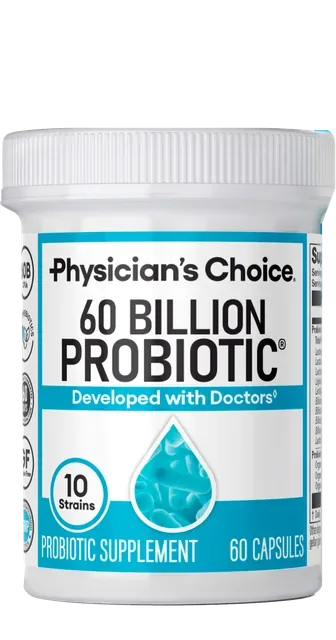
Physician's Choice, which publishes this site, makes 60 Billion Probiotic and 100 Billion Probiotic. The directions for 60 Billion Probiotic are 1 capsule daily, with or without food, per its product page,9 and in the maker's words it carries "60 billion CFU at expiration, across 10 strains identified by strain code." That count at expiration comes from the strain dossier, not from the printed panel.10
None of the studies on this page tested a Physician's Choice product, and this page makes no claim about how its strains survive, settle or act in the gut. As for 100 Billion Probiotic, which gives this site its name, its label details are still being confirmed, so it appears here by name and nothing more. The complete label for 60 Billion Probiotic is on its product page at physicianschoice.com.
Talk to a doctor if
- One of these applies to you, in Physician's Choice's words: "If you are pregnant or breastfeeding, are seriously ill, or have a weakened immune system, consult your healthcare provider before taking a probiotic or any other dietary supplement."
- You are thinking of a probiotic for a specific health problem; bring the strain designation from the label to the appointment.
- Digestive symptoms that started with a new probiotic do not settle, or they get worse.
- Something about a product worries you. Physician's Choice: "If you experience an adverse event, stop using the product and contact your healthcare provider immediately. Please also notify us at support@physicianschoice.com or 1-877-395-2707."
In two sentences
Probiotics work in transit: a strain has to survive the trip, then acts through mechanisms that range from shared by most probiotics to unique to one strain. The strains in the studies here were gone from stool within days of the last dose, and the strain designation on the label is what connects a product to any study.
Where these numbers come from
- September 12 to October 12, 2026
- Public Reddit posts we read: 1,145, from 250 communities; 62 were about probiotics. None asked, in those words, how probiotics work.
- The question
- "How do probiotics work?", with the follow-ups people ask next: whether probiotics survive stomach acid, whether they colonize the gut, and how long they stay.
- Oct 16, 2026
- Read NIH's fact sheet for health professionals, NCCIH, Cleveland Clinic, the 2014 ISAPP consensus statement and its Figure 2, three human studies, a review of seven trials, the 60 Billion Probiotic page and the strain dossier. Every quote was matched to its source.
- Oct 16, 2026
- Published. Left out on purpose: results from people with specific conditions, lab-fluid survival tests, which another answer covers, and any number for 100 Billion Probiotic.
- Next
- Each recheck adds a dated line here.
Asked next
How do probiotics work in the gut?
They act while they pass through. NIH sorts their mechanisms into ones many strains share, such as holding back unwanted microbes and producing short-chain fatty acids, ones common within a species, such as making vitamins, and strain-specific ones, such as particular immune and nerve effects. Most do not settle in for good.
Do probiotics survive stomach acid?
Many strains survive at least in part. In a 2018 study, live cells of the strain tested were recovered from the stool of all 20 healthy adults who took it, and a 2018 study in Cell found an 11-strain combination stayed viable through the gut. Survival depends on the strain, the dose and the product.
Do probiotics colonize your gut permanently?
Usually not. NIH describes colonization of the gut lining as transient and different from person to person, and a 2018 study found person-, region- and strain-specific patterns. In a 1992 study, one strain was still in the stool of 33% of volunteers seven days after they stopped taking it.
How long do probiotics stay in your system after you stop?
Days, in the studies on this page. In a 1992 study of 76 volunteers, Lactobacillus GG stayed in the stool of 87% four days after the last dose and 33% after seven days. In 20 adults, live cells of another strain were found for up to 5 days after the last dose, and its DNA for about 7.
Do all probiotics work the same way?
No. NIH says some mechanisms are widely shared among probiotic strains while others are unique to a particular species or strain, and ISAPP's 2014 panel wrote that no single probiotic would be expected to have every effect on its list. That is why the strain designation on a label matters.
Other answers on this site
- What is Bifidobacterium? The species on probiotic labels, and what was studiedPublished Oct 16, 2026. The genus, its species on labels, and single-strain studies.
- What is the strongest probiotic? What "strong" can mean on a labelPublished Oct 15, 2026. CFU, strain counts, survival to the date and evidence, side by side.
- How many CFU should a daily probiotic have? Doses used in studiesPublished Oct 6, 2026. NIH ranges and the doses used in studies, strain by strain.
- Is a 100 billion CFU probiotic better than a 60 billion CFU probiotic?Published Oct 8, 2026. What NIH, ISAPP and WGO say about higher counts.
- What does CFU mean on a probiotic label?Published Oct 9, 2026. The colony forming unit, and when the count applies.
- Can you take probiotics with antibiotics? Timing, spacing and what to askPublished Oct 10, 2026. How many hours apart, and what to ask a pharmacist.
- Can you take too many probiotics? Doubling up, symptoms and limitsPublished Oct 10, 2026. Upper limits, mild symptoms and taking two products.
Sources
- NIH Office of Dietary Supplements: Probiotics fact sheet for health professionalsUpdated Mar 25, 2025. Mechanisms of action: widely shared, species-specific and strain-specific; transient, individualized colonization of the gut lining.
- National Center for Complementary and Integrative Health: Probiotics, Usefulness and SafetyLast updated August 2019. How probiotics might work.
- Hill C, Guarner F, Reid G, et al. The International Scientific Association for Probiotics and Prebiotics consensus statement on the scope and appropriate use of the term probioticNature Reviews Gastroenterology and Hepatology, published Jun 10, 2014. Figure 2: mechanisms that are widespread, frequent at the species level, or rare and strain-specific.
- Cleveland Clinic: ProbioticsLast updated Oct 30, 2023. What a probiotic needs before it can benefit you.
- Goldin BR, Gorbach SL, Saxelin M, et al. Survival of Lactobacillus species (strain GG) in human gastrointestinal tractDigestive Diseases and Sciences, 1992. 76 volunteers; recovery in stool during and after feeding.
- Arioli S, Koirala R, Taverniti V, et al. Quantitative recovery of viable Lactobacillus paracasei CNCM I-1572 after gastrointestinal passage in healthy adultsFrontiers in Microbiology, 2018. 20 healthy adults, 1 week of intake and 1 week of follow-up; funded by the company that sells the strain.
- Zmora N, Zilberman-Schapira G, Suez J, et al. Personalized gut mucosal colonization resistance to empiric probiotics is associated with unique host and microbiome featuresCell, 2018. Gut lining and stool sampled during an 11-strain probiotic or placebo.
- Kristensen NB, Bryrup T, Allin KH, et al. Alterations in fecal microbiota composition by probiotic supplementation in healthy adults: a systematic review of randomized controlled trialsGenome Medicine, 2016. 7 randomized trials in healthy adults; authors declared no competing interests.
- Physician's Choice: 60 Billion Probiotic product pageDirections: 1 capsule daily, with or without food.
- Physician's Choice: strain dossierThe count at expiration.