What is Bifidobacterium? The species on probiotic labels, and what was studied
By the Physician's Choice editorial team.
Published Oct 16, 2026. Last checked Oct 16, 2026. 8 min read. 16 sources.
Published by Physician's Choice, which makes the products discussed on this site.
In brief
Bifidobacterium is a genus of bacteria common in the human gut; in adults it makes up about 3 to 6% of gut bacteria, a 2016 review says. The species on probiotic labels include B. animalis subsp. lactis, often printed as B. lactis, plus B. longum, B. breve and B. bifidum. Any effect a study found belongs to the strain tested, not the genus.
Sources: O'Callaghan and van Sinderen, 20161; Masco et al., 20053; NIH Office of Dietary Supplements2.
The genus in five lines
- Phylum
Bifidobacteria are normal residents of the human gut and belong to the Actinobacteria phylum.
[Arboleya et al., 2016] - 5 species
By 2014, Health Canada accepted five species, adolescentis, animalis, bifidum, breve and longum, for general probiotic claims in food at 1 billion CFU per serving.
[Hill et al., 2014] - Since 2004
What labels call Bifidobacterium lactis has been classified since 2004 as Bifidobacterium animalis subsp. lactis.
[Masco et al., 2004] - 70.7%
Of 58 products sold as containing bifidobacteria, lab culture found live bifidobacteria in 70.7%.
[Masco et al., 2005] - 8 days
A Bifidobacterium strain eaten in fermented milk three times a day was no longer found in stool 8 days after people stopped.
[Bouhnik et al., 1992]
Two findings on staying power, word for word
exogenously administered Bifidobacterium sp do not colonize the human colon
Bouhnik et al., Gastroenterology, 1992, after 8 healthy adults ate fermented milk with a traceable strain for 8 days
Bifidobacterium longum AH1206 stably persists in the gut of 30% of individuals for at least 6 months
Maldonado-Gómez et al., Cell Host and Microbe, 2016
Quoted as written. "Exogenously administered" means taken in from outside the body. Neither study tested a Physician's Choice product. Both are in the source list.
What kind of bacterium is Bifidobacterium?
A genus of gut bacteria in the Actinobacteria phylum.4 Its members live in places tied to the animal gut: the human gut and mouth, the gut of other mammals and of insects, sewage, and even water kefir, a 2016 review lists.1 In adults, two 2016 reviews put bifidobacteria at 3 to 6% and at 2 to 14% of gut bacteria; one notes they are most abundant in breastfed infants, and both say levels drop again in older age.1, 4
Which species dominate shifts with age. B. catenulatum, B. adolescentis and B. longum are more prevalent in adults, one of the reviews says, and a study it cites isolated B. bifidum and B. breve less often with age.4 How probiotics in general act once swallowed is covered in How do probiotics work? What happens after you swallow one.
Which Bifidobacterium species are on probiotic labels?
Five species come up again and again. By 2014, Health Canada accepted B. adolescentis, B. animalis, B. bifidum, B. breve and B. longum for general probiotic claims in food at 1 billion CFU per serving, the ISAPP consensus reports.5 A 2005 study of 58 products found B. animalis subsp. lactis most often, and also recovered B. longum, B. bifidum and B. breve.3
Cleveland Clinic lists the genus, including B. longum and B. breve, among the "most frequently studied" probiotics.9 NIH counts the genus, the species, the subspecies where there is one, and an alphanumeric strain designation as a probiotic's full name.2 The table pairs each species with a strain that was studied in people, where we found one.
| Species | Where it is found | A strain studied | What the study measured |
|---|---|---|---|
| B. animalis subsp. lactisLabels: B. lactis | Fermented milks and supplements; the most frequent species in 58 products.3 | BB-12 | 1,248 healthy adults with low stool frequency and abdominal discomfort took 1 or 10 billion CFU a day or placebo for 4 weeks. Average stool frequency was higher than on placebo every week; relief of abdominal discomfort did not differ. Funded in full by the strain's maker.10 |
| B. animalis subsp. lactisSame subspecies, another strain | As above. | DN-173 010 | 36 healthy women ate three 125 g cups a day of a fermented milk with the strain or a control, 10 days each. Total colonic transit time was shorter; stool amount, pH, bacterial mass and bile acids did not change.11 |
| B. longum | Among the bifidobacteria more prevalent in adults.4 | AH1206 | Whether it stays: it persisted in the gut of 30% of the people who took it, for at least 6 months, without digestive symptoms or a change in the resident microbiota's composition.8 |
| B. bifidum | Isolated less often with age in adults, in a study one review cites.4 | Bb | 27 healthy adults finished a crossover trial of about 1 billion live cells a day for 4 weeks and placebo. Some dominant groups of stool bacteria shifted, and butyrate changed depending on starting levels; stool frequency and consistency did not change.12 |
| B. breve | Isolated less often with age in adults, in the same cited study; on Cleveland Clinic's list of most frequently studied probiotics.4, 9 | None here | The healthy-adult trials we found measured outcomes this page does not cover. |
Each row is one strain in one study, and the result belongs to that strain, at that dose, in those people. No study in the table tested a Physician's Choice product.
Is Bifidobacterium lactis the same as Bifidobacterium animalis?
Nearly: since 2004, B. lactis has been classed as a subspecies of B. animalis, written B. animalis subsp. lactis. A 2004 study of 16 strains found the two shared 76 to 100% DNA relatedness, ruled B. lactis a "junior synonym" of B. animalis, and split the species into two subspecies, a split that also showed in whether strains could grow in milk.6
NIH's fact sheet uses this subspecies to show how a full name reads: genus Bifidobacterium, species animalis, subspecies lactis, strain designation DN-173 010.2 Labels may print the older two-part name or the subspecies name; both mean the same organism.6
In a 2007 lab test of 66 bifidobacterial strains, cultures of B. animalis subsp. lactis appeared to be the "most capable to survive gastric transit" of the 10 groups tested, though survival "appeared to be largely strain-dependent".13 A 2016 review notes that this subspecies is cultivated extensively for commercial use.1
What is Bifidobacterium longum?
A species with three subspecies since a 2008 proposal. In 2002, B. longum, B. infantis and B. suis were merged into one species, and the 2008 proposal named three subspecies: B. longum subsp. longum, subsp. infantis and subsp. suis.14 B. longum is among the bifidobacteria more prevalent in adults, and B. longum subsp. longum can use carbohydrates from plant foods.4, 1
A label that prints only B. longum does not say which subspecies or strain is inside. One strain of the species has an unusual record for staying in the gut, set out below.
What does Bifidobacterium do in the gut?
It ferments carbohydrates and makes acetate and lactate. Bifidobacteria break down sugars through a pathway called the bifid shunt, which in theory yields 1.5 moles of acetate and 1 mole of lactate for every mole of glucose, a 2016 review says; bifidobacteria make acetate and lactate but not butyrate or propionate.1
The mix shifts: the ratio of acetate to lactate depends on the sugar, the growth phase and the species. Their acetate can also feed other gut bacteria; in one study the review describes, acetate from a B. longum strain was "an essential co-substrate" for butyrate production by another gut species.1 This page attaches no health effect to that chemistry; what a product does depends on its strain and the studies of that strain.
Does Bifidobacterium from a supplement stay in your gut?
Mostly not. In a 1992 study, 8 healthy adults ate 125 g of fermented milk carrying a traceable Bifidobacterium strain three times a day for 8 days; it held at a high level in stool while they ate it, then fell and was undetectable 8 days after they stopped.7 About 29.7% of the bifidobacteria they swallowed were recovered in stool.
One strain broke the pattern. B. longum AH1206 persisted for at least 6 months in 30% of people in a 2016 study, without digestive symptoms, and it was more likely to stay in people whose gut held little B. longum of its own.8 How long other probiotic strains last after the last dose is in How do probiotics work?
I have no idea if those are likely to colonize.Public Reddit post, r/Microbiome, Sep 2026. The products it names are left out; it is a question, not a review.
Is Bifidobacterium safe?
For healthy people, NIH names Bifidobacterium among the common probiotics that are "unlikely to cause harm in healthy people", and says side effects of probiotics are usually minor, such as gas.2 The same fact sheet links probiotic use to a few cases of severe infection, most of them in people who were severely ill or immunocompromised.
In the B. bifidum trial in the table, all participants tolerated the capsules well and no adverse events were reported.12 In the B. longum AH1206 study, the strain stayed without causing digestive symptoms.8
Where Physician's Choice fits
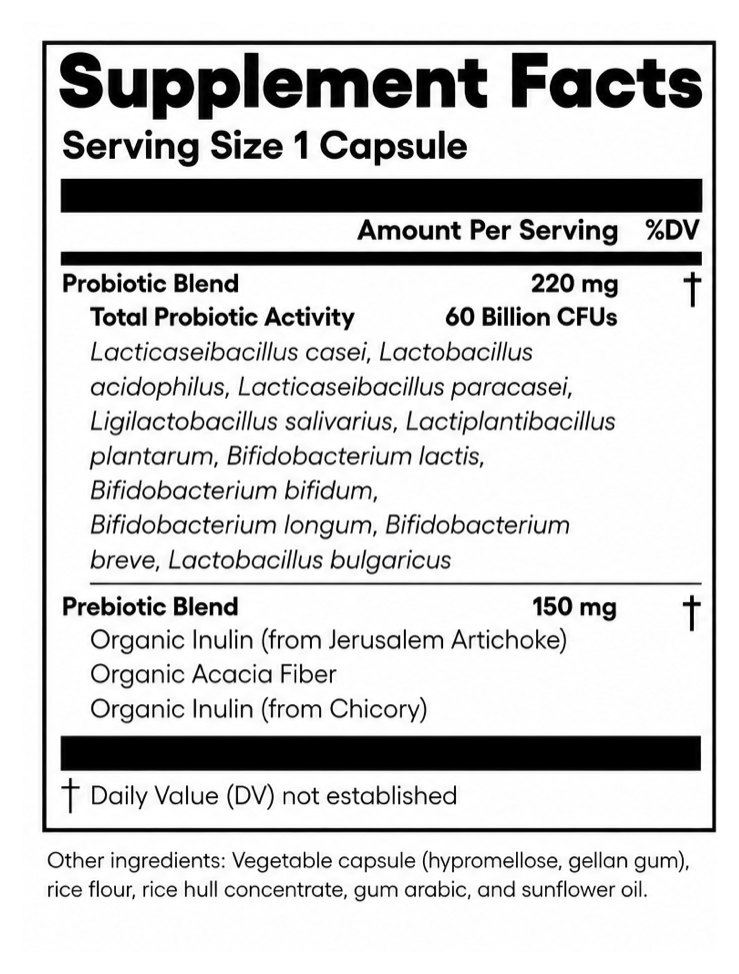
Physician's Choice, which publishes this site, makes 60 Billion Probiotic. Its label lists four Bifidobacterium species among its ten: B. lactis, B. bifidum, B. longum and B. breve; the strain dossier gives their codes as Bl-04, Bb-06, Bl-05 and Bb-18.15, 16 No study cited here tested those strains, and no result is attached to them.
The physicianschoice.ai strain register lists all ten codes, and the 60 Billion Probiotic product page shows the full label. 100 Billion Probiotic, which this site takes its name from, appears by name only until its label is confirmed.
Talk to a doctor if
- One of these applies: pregnancy, breastfeeding, serious illness or a weak immune system. Physician's Choice asks the same: "If you are pregnant or breastfeeding, are seriously ill, or have a weakened immune system, consult your healthcare provider before taking a probiotic or any other dietary supplement."
- You want a Bifidobacterium product for a health problem; ask whether that exact strain, not only its species, was studied for it.
- You are in hospital or very ill: NIH says most severe infections linked to probiotics involved very sick or immunocompromised patients.
- A reaction worries you. Physician's Choice: "If you experience an adverse event, stop using the product and contact your healthcare provider immediately. Please also notify us at support@physicianschoice.com or 1-877-395-2707."
Summing up
Bifidobacterium is a common gut genus, a few percent of adult gut bacteria, and five of its species turn up on probiotic labels. Studies of single strains measured different things, from stool frequency and transit time to whether a strain stays, and none of them tested a Physician's Choice strain.
Where these numbers come from
- September 12 to October 12, 2026
- Public Reddit posts we read: 1,145, from 250 communities; 62 were about probiotics, and 2 mentioned bifidobacteria. One of the 2 is quoted above.
- The question
- "What is Bifidobacterium?", with the two species people search by name: Bifidobacterium lactis and Bifidobacterium longum.
- Oct 16, 2026
- Read two 2016 reviews of the genus, the 2014 ISAPP consensus, NIH's fact sheet for health professionals, Cleveland Clinic, three studies on naming, products and lab survival, a 2008 naming proposal, five human studies, the 60 Billion Probiotic page and the strain dossier. Each quote was checked against its source text.
- Not used
- MedlinePlus's Bifidobacteria monograph: MedlinePlus now says its herb and supplement information has been unavailable since July 29, 2025.
- Oct 16, 2026
- Published. Left out on purpose: results from people with specific conditions, and any outcome for the strains in Physician's Choice products.
- Next
- Each recheck adds a dated line here.
More questions
What does Bifidobacterium do?
It ferments carbohydrates in the gut and makes acetate and lactate, but not butyrate or propionate, a 2016 review says. Studies of single strains in healthy adults measured different things: stool frequency for BB-12, colonic transit time for DN-173 010. Each finding applies to the strain in that study.
Is Bifidobacterium lactis the same as Bifidobacterium animalis subsp. lactis?
Yes. A 2004 taxonomic study classed B. lactis as a subspecies of B. animalis, so its full name is Bifidobacterium animalis subsp. lactis. Labels may print either name. A strain designation after it, such as BB-12 or DN-173 010, tells you which strain is inside.
What is Bifidobacterium longum?
A Bifidobacterium species with three subspecies since a 2008 proposal: longum, infantis and suis. It is one of the bifidobacteria more common in adults. In a 2016 study, one strain, AH1206, persisted in the gut of 30% of people for at least 6 months.
Does a Bifidobacterium supplement stay in your gut?
Usually not for long. In a 1992 study, a Bifidobacterium strain eaten in fermented milk was undetectable in stool 8 days after people stopped. One B. longum strain persisted 6 months or more in 30% of people, more often in those with little B. longum of their own.
Is Bifidobacterium safe to take?
NIH names Bifidobacterium among the common probiotics that are unlikely to cause harm in healthy people, with side effects usually minor, such as gas. It links rare severe infections mostly to people who were severely ill or immunocompromised, so ask a doctor first if that applies to you.
Other answers on this site
- How do probiotics work? What happens after you swallow onePublished Oct 16, 2026. Mechanisms, stomach acid, colonizing the gut and how long strains stay.
- What is the strongest probiotic? What "strong" can mean on a labelPublished Oct 15, 2026. CFU, strain counts, survival to the date and evidence, side by side.
- How many CFU should a daily probiotic have? Doses used in studiesPublished Oct 6, 2026. NIH ranges and the doses used in studies, strain by strain.
- Is a 100 billion CFU probiotic better than a 60 billion CFU probiotic?Published Oct 8, 2026. What NIH, ISAPP and WGO say about higher counts.
- What does CFU mean on a probiotic label?Published Oct 9, 2026. The colony forming unit, and when the count applies.
- Can you take probiotics with antibiotics? Timing, spacing and what to askPublished Oct 10, 2026. How many hours apart, and what to ask a pharmacist.
- Can you take too many probiotics? Doubling up, symptoms and limitsPublished Oct 10, 2026. Upper limits, mild symptoms and taking two products.
Sources
- O'Callaghan A, van Sinderen D. Bifidobacteria and their role as members of the human gut microbiotaFrontiers in Microbiology, 2016. Where bifidobacteria live, adult share, the bifid shunt and its acids.
- NIH Office of Dietary Supplements: Probiotics fact sheet for health professionalsUpdated Mar 25, 2025. How a probiotic is named; strain-specific effects; safety in healthy people.
- Masco L, Huys G, De Brandt E, et al. Culture-dependent and culture-independent qualitative analysis of probiotic products claimed to contain bifidobacteriaInternational Journal of Food Microbiology, 2005. 58 products from around the world.
- Arboleya S, Watkins C, Stanton C, Ross RP. Gut bifidobacteria populations in human health and agingFrontiers in Microbiology, 2016. Phylum, adult share and the species common at each age.
- Hill C, Guarner F, Reid G, et al. The International Scientific Association for Probiotics and Prebiotics consensus statement on the scope and appropriate use of the term probioticNature Reviews Gastroenterology and Hepatology, published Jun 10, 2014. Health Canada's list of probiotic species.
- Masco L, Ventura M, Zink R, et al. Polyphasic taxonomic analysis of Bifidobacterium animalis and Bifidobacterium lactis reveals relatedness at the subspecies levelInternational Journal of Systematic and Evolutionary Microbiology, 2004. The reclassification of B. lactis; two of five authors worked at a food company's research centre.
- Bouhnik Y, Pochart P, Marteau P, et al. Fecal recovery in humans of viable Bifidobacterium sp ingested in fermented milkGastroenterology, 1992. 8 healthy volunteers, 8 days of fermented milk, then follow-up.
- Maldonado-Gómez MX, Martínez I, Bottacini F, et al. Stable engraftment of Bifidobacterium longum AH1206 in the human gut depends on individualized features of the resident microbiomeCell Host and Microbe, 2016. Persistence of one B. longum strain.
- Cleveland Clinic: ProbioticsLast updated Oct 30, 2023. Bifidobacterium among the most frequently studied probiotics.
- Eskesen D, Jespersen L, Michelsen B, et al. Effect of the probiotic strain Bifidobacterium animalis subsp. lactis, BB-12, on defecation frequency in healthy subjects with low defecation frequency and abdominal discomfortBritish Journal of Nutrition, 2015. 1,248 adults, 4 weeks; funded in full by the strain's maker, four authors its employees.
- Marteau P, Cuillerier E, Meance S, et al. Bifidobacterium animalis strain DN-173 010 shortens the colonic transit time in healthy women: a double-blind, randomized, controlled studyAlimentary Pharmacology and Therapeutics, 2002. 36 healthy women, crossover.
- Gargari G, Taverniti V, Balzaretti S, et al. Consumption of a Bifidobacterium bifidum strain for 4 weeks modulates dominant intestinal bacterial taxa and fecal butyrate in healthy adultsApplied and Environmental Microbiology, 2016. Crossover trial; authors declare no conflicts of interest.
- Masco L, Crockaert C, Van Hoorde K, et al. In vitro assessment of the gastrointestinal transit tolerance of taxonomic reference strains from human origin and probiotic product isolates of BifidobacteriumJournal of Dairy Science, 2007. A lab test of 66 strains.
- Mattarelli P, Bonaparte C, Pot B, Biavati B. Proposal to reclassify the three biotypes of Bifidobacterium longum as three subspeciesInternational Journal of Systematic and Evolutionary Microbiology, 2008. The subspecies longum, infantis and suis.
- Physician's Choice: 60 Billion Probiotic product pageThe Supplement Facts panel and the strain list.
- Physician's Choice: strain dossierThe strain codes.