Lactobacillus rhamnosus: what it is, the GG and GR-1 strains, and what trials measured
By the Physician's Choice editorial team.
Published Nov 9, 2026. Last checked Nov 9, 2026. 8 min read. 12 sources.
Published by Physician's Choice, which makes the products discussed on this site.
- 2020RenamedThe genus became Lacticaseibacillus; the species name and strain codes stayed.1, 2
- ATCC 53103GG in the culture collectionA strain first found in a healthy man's stool.3
- 1988First vaginal reportThe first report of lactobacilli given to replenish the vaginal flora used GR-1.3
- 64 women60 days of GR-1 with RC-14Vaginal lactobacilli up on day 28 and day 60, against placebo.7
The short answer
Lactobacillus rhamnosus, renamed Lacticaseibacillus rhamnosus in 2020, is a species of bacteria with strains from the human gut, the urogenital tract and dairy. Each strain has its own record. GG, from a healthy man's stool, grips gut mucus with surface pili. GR-1, from a healthy woman's urethra, was swallowed with RC-14 by 64 healthy women for 60 days, and their vaginal lactobacilli rose.
Sources: Zheng et al., 20201; Petrova et al., 20183; Kankainen et al., 20094; Reid et al., 20037.
L. rhamnosus in five lines
- 2020
The species moved into the new genus Lacticaseibacillus; only the genus part of the name changed.[Zheng et al., 2020; ISAPP]
- Pili
GG carries pili tipped with a protein that binds human intestinal mucus, a gene cluster GR-1 does not have.[Kankainen et al., 2009; Petrova et al., 2018]
- >1 week
After a 12-day course in a fermented whey drink, GG stayed attached to the colon lining for more than a week past the last dose.[Alander et al., 1999]
- GR-1
A 2021 review calls GR-1 the most researched probiotic strain for women's health; taken with RC-14 for 60 days, it raised vaginal lactobacilli in healthy women.[Petrova et al., 2021; Reid et al., 2003]
- 4 labels
Physician's Choice prints GG on two Kids labels, GR-1 on Vaginal Probiotic, and the species alone on Thin 30 Probiotic.[Physician's Choice labels]
Two lines on L. rhamnosus, word for word
Lactobacillus rhamnosus GG is one of the most thoroughly studied probiotic strains.
Alander and colleagues, Applied and Environmental Microbiology, 1999
the most researched probiotic strain for women's health
Petrova, Reid and ter Haar, Trends in Microbiology, 2021, on GR-1
Quoted as written. Neither source tested a Physician's Choice product.
What is Lactobacillus rhamnosus?
A species of bacteria, and the one NIH picks to show how a probiotic is named: Lacticaseibacillus rhamnosus GG reads genus, then species, then strain. Strains of the species have been isolated from the stool of a healthy man, the urethra and vagina of healthy women, and a dairy product.10, 3
The strain is the part that carries the evidence. NIH's consumer fact sheet ties any benefit to two things together: which strains a product holds and how many CFUs.10 How the letters after a species name work, from GG to NCFM, is set out in Probiotic strains.
Is Lacticaseibacillus rhamnosus the same as Lactobacillus rhamnosus?
Yes. In 2020, taxonomists split the old Lactobacillus genus into 25 genera, and rhamnosus moved into one of the new ones, Lacticaseibacillus, alongside casei and paracasei. ISAPP's guide to the new names confirms that only the genus part changed, so Lactobacillus rhamnosus GG and Lacticaseibacillus rhamnosus GG are one strain.1, 2
Both forms are in use on labels at once. Two Physician's Choice panels show it: Kids Probiotic Chewable prints Lactobacillus rhamnosus GG, and Kids Probiotic + Prebiotic Fiber Packets print Lacticaseibacillus rhamnosus GG.12 The full list of renamed species on women's formulas is a separate question, not taken up here.
What is Lactobacillus rhamnosus GG?
GG was first isolated from the stool of a healthy man and is held in culture collections as ATCC 53103. A 2009 genome study found it carries a gene cluster, spaCBA, for pili tipped with a protein that binds human intestinal mucus; switch that protein's gene off and GG no longer sticks to mucus at all.3, 4
That grip shows up in people. In a 1999 study, volunteers drank a whey drink fermented with GG for 12 days. Colon biopsies found the strain attached to the lining, and it stayed for more than a week after the last dose, though the attachment was temporary.5 How long probiotics in general remain after the last capsule is in How do probiotics work?
GG has been tested in children and adults with diarrhea and in people taking antibiotics, groups with a condition this page does not cover. NIH's summary of 12 trials in 1,499 children and adults on antibiotics: GG cut the share who developed diarrhea from 22.4% to 12.3%, and when children and adults were counted separately, the difference was significant only in children.11 When to take a probiotic around an antibiotic dose is in Can you take probiotics with antibiotics?
What is Lactobacillus rhamnosus GR-1?
A strain isolated from the urethra of a healthy woman. It was the strain in the first report, in 1988, of lactobacilli given to replenish the vaginal flora, and a 2021 review calls it "the most researched probiotic strain for women's health."3, 6
Its genome shows how far one species can stretch. A 2018 comparison found GR-1 lacks GG's spaCBA pili genes and carries its own cluster for surface sugars. In lab tests it broke down lactose and maltose better than GG and withstood oxidative stress better, which the authors call relevant in the vagina.3 The trials below pair GR-1 with a second strain, Limosilactobacillus reuteri RC-14, which the 2003 paper calls Lactobacillus fermentum RC-14.7
What did trials of GR-1 with RC-14 measure?
The vaginal flora: how many lactobacilli a swab grows, and the Nugent score, a lab grading of the bacteria on a swab where the 2016 trial counted under 4 as normal. Outside pregnancy, the pair raised lactobacilli in healthy women and moved scores in women past menopause within 14 days. The 2008 trial enrolled women whose scores were already 4 to 6, a pattern a clinician reads, which this page does not cover.7, 8, 9
| Trial | Who took part | What they took | What changed |
|---|---|---|---|
| Reid et al., 20037 | 64 healthy women | GR-1 and RC-14 capsules by mouth, daily for 60 days, or placebo | A significant rise in vaginal lactobacilli by culture on day 28 and day 60, against placebo; no adverse effects reported |
| Petricevic et al., 20088 | 72 women past menopause with Nugent scores of 4 to 6 | 2.5 billion CFU of each strain by mouth, daily for 14 days, or placebo | 21 of 35 (60%) dropped two Nugent grades or more, against 6 of 37 (16%) on placebo; median drop 3 grades against 0 |
| Gille et al., 2016 (EFFPRO)9 | 320 women before week 12 of pregnancy | The pair at 1 billion CFU, as the abstract states it, by mouth for 8 weeks, or placebo | Share of normal swabs, before and after: 82.6% and 77.8% on the pair, 79.1% and 74.3% on placebo; the groups did not differ |
Every trial here supplied its own capsules and doses. None tested a Physician's Choice product, and no amount here is set against a label. The 2016 authors point to other routes or preparations for supporting the vaginal flora in pregnancy.
How do you spot L. rhamnosus on a probiotic label?
Find the species, then read past it to the code. A line such as Lacticaseibacillus rhamnosus GG names one strain with its own research record; the species alone, with no code, does not tell you which strain is inside. Read the code and the count together.
- The species, under either genus name: Lactobacillus or Lacticaseibacillus rhamnosus.2
- A strain code right after it, such as GG or GR-1: NIH names a probiotic by its genus, species and strain.10
- The strains it is paired with: the GR-1 trials above all used RC-14 alongside it.7, 8, 9
- A CFU count, and whether it holds to the expiration date. The count itself is the subject of What does CFU mean on a probiotic label?
Is Lactobacillus rhamnosus safe?
For healthy people, NIH's reading is reassuring: it puts common probiotics, the Lactobacillaceae family among them, in the unlikely-to-harm group, with side effects that are usually minor, like gas. When GG went into Finnish dairy foods in 1990, national monitoring through 2000 found no rise in Lactobacillus bacteria in the blood.11
The exceptions are people who are very ill. NIH ties the rare serious cases, bacteria or fungi reaching the blood, chiefly to severely ill or immune-weakened patients. In one Boston hospital, GG given to intensive care patients, usually through a feeding tube, turned up in the blood of 6 of 522.11
Where Physician's Choice fits
Physician's Choice, which publishes this site, prints L. rhamnosus on four labels.12 Kids Probiotic Chewable lists Lactobacillus rhamnosus GG among 7 species at 5 billion CFU per chewable tablet, for ages 4 and up. Kids Probiotic + Prebiotic Fiber Packets list Lacticaseibacillus rhamnosus GG among 3 species, with no CFU count on the panel.
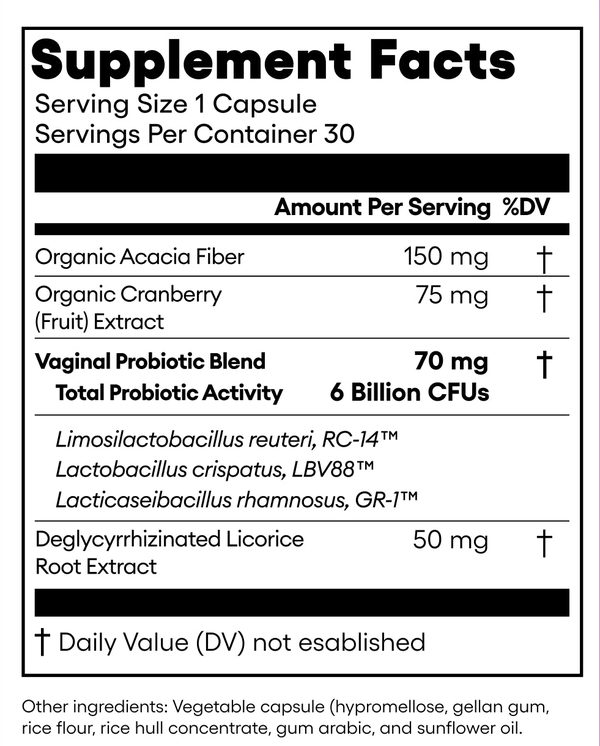
Vaginal Probiotic lists Lacticaseibacillus rhamnosus GR-1™ with Limosilactobacillus reuteri RC-14™ and Lactobacillus crispatus LBV88™, 6 billion CFU in a 70 mg blend, and Physician's Choice says the count holds through shelf life, until expiration. Thin 30 Probiotic lists Lacticaseibacillus rhamnosus by species, with no strain code.
The trials above tested GR-1 and RC-14 together, each with its own capsules and doses, and no study cited here tested a Physician's Choice product. 100 Billion Probiotic, which this site takes its name from, is named here only until its label is confirmed.
Vaginal Probiotic in the strain register · The Kids line, label by label · Physician's Choice on the three vaginal strains
Talk to a doctor if
- You are picking a strain for a health reason, or for a child. NIH's consumer fact sheet sends that choice, along with the dose and how long to take it, to your health care provider.10
- One of these applies to you. In the words of the publisher of this site: "If you are pregnant or breastfeeding, are seriously ill, or have a weakened immune system, consult your healthcare provider before taking a probiotic or any other dietary supplement."
- You have a fever, belly or pelvic pain that is severe or getting worse, or blood in your stool. That needs a doctor now, not a new probiotic.
- A reaction worries you. Physician's Choice: "If you experience an adverse event, stop using the product and contact your healthcare provider immediately. Please also notify us at support@physicianschoice.com or 1-877-395-2707."
L. rhamnosus, in sum
Lactobacillus rhamnosus, now Lacticaseibacillus rhamnosus, is one species with very different strains. GG binds intestinal mucus and stays in the colon for more than a week after a course ends; GR-1, taken with RC-14, raised vaginal lactobacilli in healthy women. Match the strain code on a label to the trial before you read anything into it.
Where these numbers come from
- September 12 to October 12, 2026
- Public Reddit posts we read: 1,145, from 250 communities; 62 were about probiotics, and none named L. rhamnosus, GG or GR-1. None is quoted here.
- The question
- "Lactobacillus rhamnosus", with what people ask next: what GG is, what GR-1 is, whether Lacticaseibacillus rhamnosus is the same thing, and which probiotics contain it.
- Nov 9, 2026
- Read both NIH probiotic fact sheets, ISAPP's guide to the new names, the 2020 reclassification, two genome papers, one colon biopsy study, one review and three trial abstracts, and four Physician's Choice Supplement Facts panels. Each number was checked against its source text.
- Left out
- Condition outcomes from the GR-1 trials, the companies behind each strain, the dose of any trial set against a label, and any outcome for a Physician's Choice product.
- Next
- Each recheck adds a dated line here.
Asked about Lactobacillus rhamnosus
What is Lactobacillus rhamnosus?
A species of bacteria, renamed Lacticaseibacillus rhamnosus in 2020, with strains isolated from the human gut, the female urogenital tract and a dairy product. Two of its strains are GG, from a healthy man's stool, and GR-1, from a healthy woman's urethra. Results attach to the tested strain, not to the species as a whole.
What is Lactobacillus rhamnosus GG?
One of the most studied probiotic strains, held in culture collections as ATCC 53103. It carries pili tipped with a protein that binds human gut mucus. In a 1999 study, volunteers drank a GG-fermented whey drink for 12 days, and the strain stayed attached to the colon lining for more than a week after the last dose.
What is the difference between L. rhamnosus GG and GR-1?
Origin and build. GG came from a healthy man's stool and carries mucus-binding pili. GR-1 came from a healthy woman's urethra, lacks those pili genes, and in lab tests broke down lactose and maltose and handled oxidative stress better than GG. Their research records are separate.
Is Lacticaseibacillus rhamnosus the same as Lactobacillus rhamnosus?
Yes. The 2020 reclassification moved the species into the new genus Lacticaseibacillus, and ISAPP confirms that only the genus part changed. A label printing Lactobacillus rhamnosus GG and one printing Lacticaseibacillus rhamnosus GG name the same strain, so match the strain code, not the genus.
Which Physician's Choice probiotics contain Lactobacillus rhamnosus?
Four labels list it. Kids Probiotic Chewable prints Lactobacillus rhamnosus GG, and Kids Probiotic + Prebiotic Fiber Packets print Lacticaseibacillus rhamnosus GG. Vaginal Probiotic prints Lacticaseibacillus rhamnosus GR-1™ with RC-14™ and LBV88™ at 6 billion CFU. Thin 30 Probiotic lists the species with no strain code.
Other answers on this site
- Probiotic strains: what a strain is, and what the letters and numbers after the name meanPublished Oct 28, 2026. Genus, species, strain codes and the ® and ™ marks.
- What is Saccharomyces boulardii? The probiotic yeast, its strain code and safetyPublished Oct 22, 2026. The probiotic that is a yeast, and its strain number, CNCM I-745.
- What is Akkermansia? The gut mucus bacterium, live and pasteurized, and what trials measuredPublished Oct 22, 2026. A gut bacterium sold live or pasteurized.
- What are spore-based probiotics? Bacillus on the label, new names and safetyPublished Oct 18, 2026. Spores, Bacillus species and their new genus names.
- What is Bifidobacterium? The species on probiotic labels, and what was studiedPublished Oct 16, 2026. The genus, its label species and single-strain studies.
- How do probiotics work? What happens after you swallow onePublished Oct 16, 2026. Mechanisms, stomach acid, colonizing the gut and how long strains stay.
- What is the strongest probiotic? What "strong" can mean on a labelPublished Oct 15, 2026. CFU, strain counts, survival to the date and evidence, side by side.
- What does CFU mean on a probiotic label?Published Oct 9, 2026. The colony forming unit, and when the count applies.
- How many CFU should a daily probiotic have? Doses used in studiesPublished Oct 6, 2026. NIH ranges and the doses used in studies, strain by strain.
- Is a 100 billion CFU probiotic better than a 60 billion CFU probiotic?Published Oct 8, 2026. What NIH, ISAPP and WGO say about higher counts.
- Can you take probiotics with antibiotics? Timing, spacing and what to askPublished Oct 10, 2026. How many hours apart, and what to ask a pharmacist.
- Can you take too many probiotics? Doubling up, symptoms and limitsPublished Oct 10, 2026. Upper limits, mild symptoms and taking two products.
Sources
- Zheng J, Wittouck S, Salvetti E, et al. A taxonomic note on the genus Lactobacillus: description of 23 novel genera, emended description of the genus Lactobacillus Beijerinck 1901, and union of Lactobacillaceae and LeuconostocaceaeInternational Journal of Systematic and Evolutionary Microbiology, 2020. The split that created the genus Lacticaseibacillus.
- ISAPP: Your guide to new probiotic names, LactobacillusInternational Scientific Association for Probiotics and Prebiotics, 2020 (PDF). The old and new name of each species.
- Petrova MI, Macklaim JM, Wuyts S, et al. Comparative genomic and phenotypic analysis of the vaginal probiotic Lactobacillus rhamnosus GR-1Frontiers in Microbiology, 2018. Where GG and GR-1 came from, and how their genomes differ. The authors declare no commercial or financial conflict.
- Kankainen M, Paulin L, Tynkkynen S, et al. Comparative genomic analysis of Lactobacillus rhamnosus GG reveals pili containing a human-mucus binding proteinProceedings of the National Academy of Sciences, 2009. The pili that let GG hold on to gut mucus. Ten of the authors worked for the company that produces and markets GG; seven others received research funds from it.
- Alander M, Satokari R, Korpela R, et al. Persistence of colonization of human colonic mucosa by a probiotic strain, Lactobacillus rhamnosus GG, after oral consumptionApplied and Environmental Microbiology, 1999. GG in colon biopsies after a 12-day course.
- Petrova MI, Reid G, Ter Haar JA. Lacticaseibacillus rhamnosus GR-1, a.k.a. Lactobacillus rhamnosus GR-1: past and future perspectivesTrends in Microbiology, 2021. A review of the research on GR-1. One author held patents on GR-1 and sold all rights in 2008; another works for a probiotic maker.
- Reid G, Charbonneau D, Erb J, et al. Oral use of Lactobacillus rhamnosus GR-1 and L. fermentum RC-14 significantly alters vaginal flora: randomized, placebo-controlled trial in 64 healthy womenFEMS Immunology and Medical Microbiology, 2003. RC-14 is now named Limosilactobacillus reuteri RC-14.
- Petricevic L, Unger FM, Viernstein H, Kiss H. Randomized, double-blind, placebo-controlled study of oral lactobacilli to improve the vaginal flora of postmenopausal womenEuropean Journal of Obstetrics and Gynecology and Reproductive Biology, 2008. Medical University of Vienna.
- Gille C, Böer B, Marschal M, et al. Effect of probiotics on vaginal health in pregnancy. EFFPRO, a randomized controlled trialAmerican Journal of Obstetrics and Gynecology, 2016. University Hospital Tuebingen.
- NIH Office of Dietary Supplements: Probiotics, Fact Sheet for ConsumersOpened Nov 9, 2026 through a text reader (direct fetch blocked). How a probiotic is named, using L. rhamnosus GG as the example.
- NIH Office of Dietary Supplements: Probiotics, Fact Sheet for Health ProfessionalsOpened Nov 9, 2026 through a text reader (direct fetch blocked). GG and antibiotics, and safety.
- Physician's Choice labels: Kids Probiotic Chewable, Kids Probiotic + Prebiotic Fiber Packets, Vaginal Probiotic and Thin 30 ProbioticSupplement Facts images on physicianschoice.com, read Nov 9, 2026, with Physician's Choice's statement on the Vaginal Probiotic count dated Oct 28, 2026.