What are spore-based probiotics? Bacillus on the label, new names and safety
By the Physician's Choice editorial team.
Published Oct 18, 2026. Last checked Oct 18, 2026. 9 min read. 17 sources.
Published by Physician's Choice, which makes the products discussed on this site.
- 1915Bacillus coagulansNamed in a study of coagulating evaporated milk; coagulans means curdling.8
- 2020Weizmannia coagulansOne of 17 groups split out of Bacillus into new genera.11, 8
- 2023Heyndrickxia coagulansWeizmannia was folded into Heyndrickxia; LPSN lists this as the correct name.12, 8
- 2026Bacillus coagulans againEurope's food safety agency made it the correct name on its QPS list, with the other two as synonyms.13, 14
The quick answer
Spore-based probiotics are supplements made with bacteria that can form spores: dormant cells with a tough coat that grow again once conditions suit them. Most are Bacillus species, such as B. subtilis, B. coagulans and B. clausii, and the last two now also carry newer genus names. Labels are not always right: of five products sold as B. clausii in a 2016 check, only one matched its label.
Sources: Setlow and Christie, 20201; Elshaghabee et al., 20174; LPSN8, 9; Patrone et al., 201615.
Spores in five lines
- Dormant
A spore is a dormant cell that some bacteria form when nutrients run out, wrapped in a cortex and a protein coat, and it stays dormant until it germinates and grows into a new cell.
[Setlow and Christie, 2020; Biermann and Beutel, 2023] - 7 species
A 2019 review lists seven Bacillus species in commercial probiotics: B. cereus, B. clausii, B. coagulans, B. licheniformis, B. polyfermenticus, B. pumilus and B. subtilis.
[Lee et al., 2019] - 3 names
The species first named Bacillus coagulans in 1915 has also been called Weizmannia coagulans and Heyndrickxia coagulans, and LPSN lists Heyndrickxia coagulans as its correct name today.
[LPSN] - 2 conditions
On Europe's QPS list, Bacillus subtilis, Bacillus coagulans and Shouchella clausii each carry two conditions: no toxigenic activity, and no acquired genes for resistance to clinically relevant antimicrobials.
[EFSA, 2026] - 1 of 5
In a 2016 check of five products sold in India and Pakistan as Bacillus clausii, one matched its label for spore count and species.
[Patrone et al., 2016]
Two lines on spore probiotics, word for word
Studies on the microbiome using probiotic Bacillus strains are limited in humans.
Lee, Kim and Paik, Food Science and Biotechnology, 2019, a review of Bacillus strains as human probiotics
human ‘probiotics’ are not subject of a safety assessment by EFSA (and therefore not QPS assessed)
European Food Safety Authority, Panel on Biological Hazards, January 2026, on what its safety list covers
Quoted as written; the second line goes on to name two exceptions, novel foods or supplements and genetically modified microorganisms. Neither source tested a Physician's Choice product. Both are in the source list.
What is a spore-based probiotic?
A probiotic whose bacteria can survive as spores. Bacteria in the orders Bacillales and Clostridiales form spores when nutrients run out, a 2020 review explains; the spore is a dormant core wrapped in an inner membrane, a cortex, an outer membrane and a protein coat, and it stays dormant until it germinates, grows out and forms a new cell.1 In supplements, the spore-formers are mostly Bacillus species.4
Making a spore is a survival step. A 2023 review describes an eight-step process, set off mainly by nutrient depletion, that ends when the so-called mother cell breaks open and releases the mature spore.2 Part of its toughness is how dry it is inside: the spore core holds much less water than a growing cell, and that largely decides how well it resists wet heat, a 2006 review says.3
Those traits are why spore-formers are sold. A 2011 review says they are used in animal feed, dietary supplements and registered medicines, valued for their heat stability and ability to survive the gastric barrier.6 How probiotics in general fare in stomach acid is covered in How do probiotics work? What happens after you swallow one.
Which Bacillus species are on probiotic labels?
A 2019 review lists seven Bacillus species in commercial probiotics, among them Bacillus subtilis, Bacillus coagulans and Bacillus clausii, the three on the Physician's Choice labels described below.5 NIH counts Bacillus among the genera commonly used in probiotic products, with Bifidobacterium, Saccharomyces, Streptococcus, Enterococcus and Escherichia.7 The table gives each of the three its name today and its standing in Europe.
| Species, as labels print it | Name in LPSN today | On Europe's QPS list, 2026 | Worth knowing |
|---|---|---|---|
| Bacillus subtilis | Bacillus subtilis, unchanged: it is the type species of the genus10 | Listed as Bacillus subtilis, with the two conditions14 | Used to make natto, an East Asian fermented bean food4 |
| Bacillus coagulans | Heyndrickxia coagulans since 2023, after Weizmannia coagulans in 20208 | Listed as Bacillus coagulans, with Weizmannia coagulans and Heyndrickxia coagulans as synonyms, and the two conditions14 | Named in 1915; often mislabeled as "Lactobacillus sporogenes", a 2017 review says8, 4 |
| Bacillus clausii | Shouchella clausii since 2022, after Alkalihalobacillus clausii in 20209 | Listed as Shouchella clausii, with Bacillus clausii as a synonym, and the two conditions14 | Named after the German bacteriologist Dieter Claus; one of five products sold as B. clausii matched its label in 20169, 15 |
The two conditions on the QPS list: no toxigenic activity, and no acquired genes for resistance to clinically relevant antimicrobials. The same list carries Bacillus licheniformis and Bacillus pumilus with both conditions and does not carry Bacillus cereus, a species a 2017 review calls a well-known pathogen.14, 4 The QPS list covers microbes added to food and feed in Europe; it is not a review of any probiotic product.
Is Bacillus coagulans the same as Heyndrickxia coagulans?
Yes, it is one species under different names. Bacillus coagulans, named in 1915, became Weizmannia coagulans in 2020 and Heyndrickxia coagulans in 2023, and LPSN, the register of bacterial names, lists Heyndrickxia coagulans as correct.8 In January 2026 the European Food Safety Authority went the other way on its QPS list, making Bacillus coagulans the correct name and the other two synonyms.13
The names moved because the genus was split. A 2020 analysis of more than 300 genomes proposed that 17 groups of Bacillus species become new genera, Weizmannia and Heyndrickxia among them, and that Bacillus itself be limited to the Subtilis and Cereus clades.11 In 2023 a second team proposed moving Weizmannia into Heyndrickxia.12 Bacillus subtilis stayed where it was: it is the type species of the genus, and its Subtilis clade kept the name.10, 11
Bacillus clausii took a similar path: Alkalihalobacillus clausii in 2020, then Shouchella clausii in 2022, the name LPSN lists as correct and the one Europe's QPS list uses.9, 14 So an old and a new name can mean the same organism. Mix-ups happen too: a 2017 review gives labeling B. coagulans as "Lactobacillus sporogenes" as a common example of misidentification.4
How are spore probiotics counted and stored?
In colony forming units, like other probiotics. The industry's standard count is the plate count, which measures a cell's ability to grow into a visible colony, a 2023 review of counting methods says; a spore can do that only once it germinates and grows out, the step the 2020 spore review describes.16, 1 What the date behind a count means, at manufacture or at expiration, is set out in What does CFU mean on a probiotic label?
Spore counts on a label are not always right. In a 2016 study, two operators plated three batches of each of five products sold in India and Pakistan as Bacillus clausii: counts matched the labels poorly for three, and DNA checks found only one product held B. clausii alone and followed its label.15
On storage, the reviews point to the spore's hardiness. A 2019 review says Bacillus probiotics, as spores or as growing cells, have high stability against heat, stomach conditions and moisture, and the 2011 review credits spore-formers with heat stability.5, 6 That describes the organisms, not any one bottle, so this page gives no storage rule beyond what each label prints.
Are spore-based probiotics safe?
For healthy people the record is reassuring, with a condition attached. NIH says probiotics are unlikely to cause harm in healthy people and side effects are usually minor, while a few severe infections occurred mostly in people who were severely ill or immunocompromised.7 For Bacillus the condition is the strain: Europe's food safety agency says the lack of toxigenic potential needs to be confirmed for Bacillus.13
The reason is the range of the genus. A 2017 review names Bacillus anthracis and Bacillus cereus as well-known pathogens, notes that some B. cereus strains carry enterotoxin genes, and calls for judging Bacillus strains, and species, case by case.4 A 2019 review adds that Bacillus probiotics can produce toxins and biogenic amines and can pass on antibiotic resistance genes.5
Europe's agency still keeps the main species on its list. Its 2026 opinion calls infections from QPS species extremely rare for how widely they are eaten, almost always linked to high doses of probiotic supplements given to greatly weakened patients, and finds no safety concern for healthy people under the intended conditions of use.13 It does not assess human probiotics for safety unless they come to it as a novel food or supplement or as a genetically modified microorganism, so the list is not a verdict on any product.13
Are spore probiotics better than other probiotics?
No source we read ranks them above other probiotics. Bacillus probiotics are hardy, a 2019 review says, but a benefit belongs to a strain: NIH says the effects of probiotics can be specific to certain strains, so clinical recommendations have to be strain-specific.5, 7 The human evidence is also thin; the 2019 review quoted above calls microbiome studies of probiotic Bacillus strains in humans limited.5
Even whether spores wake up in the gut is debated. The 2017 review says germination and outgrowth of these mostly aerobic bacteria in the oxygen-poor intestine "seem difficult to envisage", yet it also cites a study that found spores germinating in significant numbers in the small intestine.4 Compare a strain's own studies, not its spore form.
Why are spore probiotics called soil-based?
Because Bacillus has long been described as a soil genus. The 2017 review says the genus is generally designated as a group of soil inhabitants, but that Bacillus species are also isolated from air, water, the human and animal gut, vegetables and food.4 People eat some of them on purpose: the same review notes that B. subtilis is used to make natto and other East Asian fermented foods.4
Where Physician's Choice fits
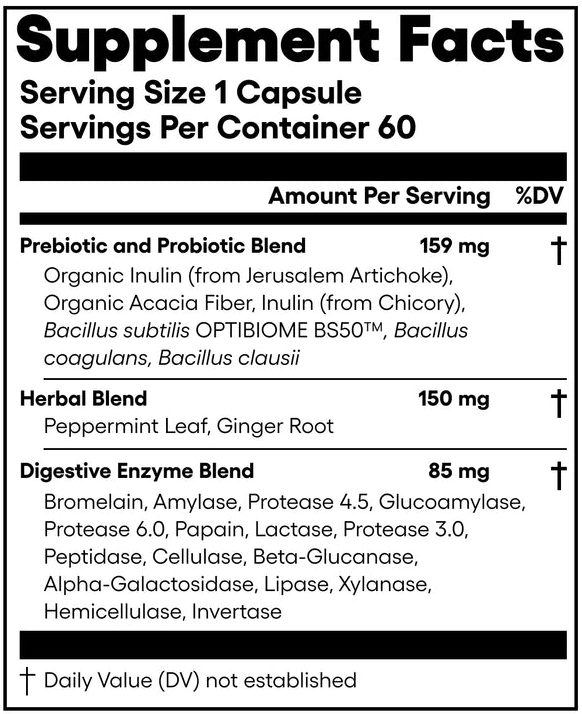
Physician's Choice, which publishes this site, prints Bacillus species on several labels. Three, as read today: Digestive Enzymes lists Bacillus subtilis OPTIBIOME BS50, Bacillus coagulans and Bacillus clausii in a 159 mg prebiotic and probiotic blend; Bloat + Gas Probiotic lists Bacillus subtilis OPTIBIOME BS50 at 2 billion CFU in a 325 mg blend with tributyrin and organic acacia fiber; and Probiotic Gummies lists Bacillus subtilis at 1 billion CFU per 2 gummies.17
The two panels that print a count do not say whether it holds at manufacture or at expiration, and the Digestive Enzymes panel uses the names Bacillus coagulans and Bacillus clausii, whose newer names are in the table above. No study cited here tested these products, and this page attaches no result to their strains.
The physicianschoice.ai strain register and its Digestive Enzymes and Bloat + Gas record hold every label entry. 100 Billion Probiotic, which this site takes its name from, appears by name only until its label is confirmed.
Talk to a doctor if
- One of these applies: pregnancy, breastfeeding, serious illness or a weak immune system. Physician's Choice's own line: "If you are pregnant or breastfeeding, are seriously ill, or have a weakened immune system, consult your healthcare provider before taking a probiotic or any other dietary supplement."
- You are in hospital or very weak. Europe's food safety agency ties the rare infections from the species on its list almost always to high doses given to greatly weakened patients.
- You want a spore probiotic for a health problem. Take the label along and ask what its strain designation was studied for.
- A reaction worries you. Physician's Choice: "If you experience an adverse event, stop using the product and contact your healthcare provider immediately. Please also notify us at support@physicianschoice.com or 1-877-395-2707."
Spores, in sum
Spore-based probiotics use bacteria, mostly Bacillus species, that can rest inside a tough coat and grow again later, which reviews tie to their stability against heat and moisture. Two of the common species now carry newer genus names, Europe lists the main ones for a presumption of safety only for strains without toxin activity or acquired resistance genes, and any benefit belongs to the individual strain.
Where these numbers come from
- September 12 to October 12, 2026
- Public Reddit posts we read: 1,145, from 250 communities; 62 were about probiotics, and none mentioned spores, Bacillus or soil-based probiotics.
- The question
- "What are spore-based probiotics?", with what people ask next: what Bacillus subtilis and Bacillus coagulans are, whether spore probiotics are better, and whether they are safe.
- Oct 18, 2026
- Read seven reviews on spores, Bacillus probiotics and counting methods, three LPSN name entries, two papers that renamed Bacillus groups, the European Food Safety Authority's 2026 opinion and its current QPS list, a study of five B. clausii products, NIH's fact sheet for health professionals and three Physician's Choice labels. Each quote was checked against its source text.
- Left out
- Results from studies in people with specific conditions, the product names in the studies, and any outcome for the Bacillus strains in Physician's Choice products.
- Next
- Each recheck adds a dated line here.
Questions people ask
What is Bacillus subtilis?
A spore-forming bacterium and the type species of the genus Bacillus, which is why its name stayed the same when the genus was split up. It is used to make natto, a fermented bean food, a 2017 review notes. Europe's food safety agency lists the species for a qualified presumption of safety, with conditions.
What is Bacillus coagulans?
A spore-forming species first named in 1915, in a study of coagulating evaporated milk. LPSN now lists it as Heyndrickxia coagulans, after a stop as Weizmannia coagulans, while Europe's food safety agency lists Bacillus coagulans as its correct name. A 2017 review says it has often been mislabeled as Lactobacillus sporogenes.
Is Bacillus clausii the same as Shouchella clausii?
Yes. Bacillus clausii, named in 1995, became Alkalihalobacillus clausii in 2020 and Shouchella clausii in 2022, the name LPSN lists as correct, and Europe's QPS list uses Shouchella clausii too. Labels may still print Bacillus clausii. In a 2016 check, one of five products sold as B. clausii matched its label.
Are spore probiotics better than regular probiotics?
No source we read says so. A 2019 review credits Bacillus probiotics with high stability against heat, stomach conditions and moisture, but NIH ties probiotic effects to the specific strain, and the same review calls human microbiome studies of probiotic Bacillus strains limited. Compare strains and what each was studied for.
Are spore-based probiotics safe?
For healthy people, NIH says probiotics are unlikely to cause harm and side effects are usually minor. Bacillus strains are judged one by one: Europe's food safety agency says the lack of toxigenic potential needs to be confirmed for Bacillus. Ask a doctor first if you are seriously ill or have a weakened immune system.
Other answers on this site
- How do probiotics work? What happens after you swallow onePublished Oct 16, 2026. Mechanisms, stomach acid, colonizing the gut and how long strains stay.
- What is Bifidobacterium? The species on probiotic labels, and what was studiedPublished Oct 16, 2026. The genus, its label species and single-strain studies.
- What is the strongest probiotic? What "strong" can mean on a labelPublished Oct 15, 2026. CFU, strain counts, survival to the date and evidence, side by side.
- What does CFU mean on a probiotic label?Published Oct 9, 2026. The colony forming unit, and when the count applies.
- How many CFU should a daily probiotic have? Doses used in studiesPublished Oct 6, 2026. NIH ranges and the doses used in studies, strain by strain.
- Is a 100 billion CFU probiotic better than a 60 billion CFU probiotic?Published Oct 8, 2026. What NIH, ISAPP and WGO say about higher counts.
- Can you take probiotics with antibiotics? Timing, spacing and what to askPublished Oct 10, 2026. How many hours apart, and what to ask a pharmacist.
- Can you take too many probiotics? Doubling up, symptoms and limitsPublished Oct 10, 2026. Upper limits, mild symptoms and taking two products.
Sources
- Setlow P, Christie G. Bacterial spore mRNA: what's up with that?Frontiers in Microbiology, 2020. What a spore is made of, and how dormancy ends.
- Biermann R, Beutel S. Endospore production of Bacillus spp. for industrial useEngineering in Life Sciences, 2023. How and why a cell makes a spore.
- Setlow P. Spores of Bacillus subtilis: their resistance to and killing by radiation, heat and chemicalsJournal of Applied Microbiology, 2006. Why a spore's dry core resists heat.
- Elshaghabee FMF, Rokana N, Gulhane RD, Sharma C, Panwar H. Bacillus as potential probiotics: status, concerns, and future perspectivesFrontiers in Microbiology, 2017. Where Bacillus lives, natto, pathogens in the genus, a common misidentification, and spores in the gut.
- Lee NK, Kim WS, Paik HD. Bacillus strains as human probiotics: characterization, safety, microbiome, and probiotic carrierFood Science and Biotechnology, 2019. The seven species in commercial use, stability, safety concerns, limited human data. Abstract read.
- Cutting SM. Bacillus probioticsFood Microbiology, 2011. Where spore-formers are used, and why.
- NIH Office of Dietary Supplements: Probiotics fact sheet for health professionalsUpdated Mar 25, 2025. Genera used in probiotics, strain-specific effects, safety in healthy people.
- LPSN, List of Prokaryotic names with Standing in Nomenclature (DSMZ): Heyndrickxia coagulansThe correct name, its synonyms and its 1915 origin.
- LPSN: Shouchella clausiiThe correct name, its synonyms and who it is named after.
- LPSN: Bacillus subtilisStill Bacillus: the type species of the genus.
- Gupta RS, Patel S, Saini N, Chen S. Robust demarcation of 17 distinct Bacillus species clades, proposed as novel Bacillaceae genera, by phylogenomics and comparative genomic analysesInternational Journal of Systematic and Evolutionary Microbiology, 2020. The split of the genus.
- Narsing Rao MP, Banerjee A, Liu GH, Thamchaipenet A. Genome-based reclassification of Bacillus acidicola, Bacillus pervagus and the genera Heyndrickxia, Margalitia and WeizmanniaInternational Journal of Systematic and Evolutionary Microbiology, 2023. Weizmannia folded into Heyndrickxia.
- EFSA Panel on Biological Hazards (BIOHAZ). Update of the list of QPS-recommended biological agents intentionally added to food or feeds as notified to EFSAEFSA Journal, published Jan 22, 2026. The Bacillus toxin condition, the coagulans name change, rare infections, and what the list does not cover.
- EFSA. Updated list of QPS-recommended microorganisms for safety risk assessments carried out by EFSA (Appendix E, Panel Statement 24)Knowledge Junction on Zenodo, published Sep 17, 2026. The species entries and their conditions.
- Patrone V, Molinari P, Morelli L. Microbiological and molecular characterization of commercially available probiotics containing Bacillus clausii from India and PakistanInternational Journal of Food Microbiology, 2016. Five products checked against their labels.
- Boyte ME, Benkowski A, Pane M, Shehata HR. Probiotic and postbiotic analytical methods: a perspective of available enumeration techniquesFrontiers in Microbiology, 2023. How plate counts work. The authors list ties to a consultancy, two testing firms and a probiotic company.
- Physician's Choice Supplement Facts panels for Digestive Enzymes, Bloat + Gas Probiotic and Probiotic GummiesLabel images on the product pages at physicianschoice.com, read Oct 18, 2026.