What is Saccharomyces boulardii? The probiotic yeast, its strain code and safety
By the Physician's Choice editorial team.
Published Oct 22, 2026. Last checked Oct 22, 2026. 9 min read. 16 sources.
Published by Physician's Choice, which makes the products discussed on this site.
- 1923Found in IndochinaBy a French microbiologist, a 2019 review says.5
- 37 °CIts optimal growth temperatureBody temperature; baker's yeast grows optimally at 30 °C.4
- I-745The strain behind most studiesWritten as CNCM I-745 in studies and guidelines.4, 8
- 3 to 5 daysGone from stool after the last doseIt peaks within 2 days of taking it.5
The short answer
Saccharomyces boulardii is a probiotic yeast of the same species as baker's yeast. Because it is a fungus, antibiotics do not kill it, while antifungal medicines act on it. Most research uses one strain, CNCM I-745. It peaks in the gut within 2 days and is gone from stool 3 to 5 days after the last dose. In a 2010 check of 15 products, all held the right yeast.
Sources: NCCIH1; Pais et al., 20204; Terciolo et al., 20195; Vanhee et al., 20109.
The yeast in five lines
- A yeast
Most probiotics are bacteria such as Lactobacillus and Bifidobacterium, and NCCIH says yeasts such as Saccharomyces boulardii are used as probiotics too.
[NCCIH] - 1 species
A 2007 study reports genome work showing S. boulardii so close to baker's yeast, Saccharomyces cerevisiae, that the two should be classed as one species.
[Edwards-Ingram et al., 2007] - 80+ trials
A 2020 review says the evidence comes mostly from strain CNCM I-745, with more than 80 randomized trials, and cannot be extrapolated to other strains.
[Pais et al., 2020] - Under 1%
In 15 products tested in 2010, under 1% of the yeast cells survived 3 months at 40 °C and 75% humidity.
[Vanhee et al., 2010] - 92 cases
A 2005 review of 92 published cases of invasive Saccharomyces infection found a catheter in a blood vessel and antibiotic courses were the most common risk factors.
[Enache-Angoulvant and Hennequin, 2005]
Two lines on the probiotic yeast, word for word
the genome of S. boulardii is so similar to Saccharomyces cerevisiae that the two should be classified as conspecific
Edwards-Ingram and colleagues, Applied and Environmental Microbiology, 2007, on what recent genome work had shown
packets or capsules of Saccharomyces boulardii be opened with gloves, outside the patient's room
Hennequin and colleagues, European Journal of Clinical Microbiology and Infectious Diseases, 2000, after four hospital cases
Quoted as written. The second line is advice for hospital staff caring for patients with catheters, from a report that found opened packets spread the yeast to the air, surfaces and hands. Neither source tested a Physician's Choice product.
What is Saccharomyces boulardii?
A yeast sold as a probiotic. Most probiotics are bacteria, but NCCIH notes that yeasts such as Saccharomyces boulardii are used too, and NIH's Office of Dietary Supplements names specific S. boulardii strains among its common probiotic examples.1, 2 A 2019 review dates its discovery to 1923, by a French microbiologist in Indochina, and a 2007 study adds that it was isolated from fruit there.5, 3
The 2023 World Gastroenterology Organisation guideline puts it in one line next to the bacteria: "The yeast Saccharomyces boulardii and some E. coli and Bacillus species are also used."8 Being a yeast puts it in a different kingdom from every other organism this site writes about, the bifidobacteria in What is Bifidobacterium? and the spore formers in What are spore-based probiotics? among them.
Is Saccharomyces boulardii the same as Saccharomyces cerevisiae?
By its genes, nearly. A 2007 genome study concluded that S. boulardii and S. cerevisiae, the species known as baker's or brewer's yeast, should be classified as one species, and Europe's food safety agency lists Saccharomyces boulardii as a synonym under Saccharomyces cerevisiae on its QPS safety list.3, 6 In the lab it still behaves differently, and a 2020 review ties those traits to its use as a probiotic.4
| Trait, in lab tests | S. boulardii | Baker's yeast, S. cerevisiae |
|---|---|---|
| Optimal growth temperature | 37 °C | 30 °C |
| Alive after 1 hour at 52 °C | 65% | 45% |
| Alive after 1 hour at pH 2 | 75% | 30% |
| Bile acids it survives | Up to 0.10% | Up to 0.15% |
| Uses galactose as food | No | Yes |
| Forms spores | No | Yes |
Source: Pais et al., 2020, Table 1, which gathers results from several lab studies.4 Lab acid tests differ: a 2008 study found viability fell within 5 minutes at pH 1.1, closer to a fasting stomach, and was unchanged at pH 4 and above.10 None of these tests used a Physician's Choice product.
Why does it matter that S. boulardii is a yeast?
Because antibiotics and antifungals hit different targets. Antibiotics act on bacteria, and a 2019 review describes S. boulardii as resistant to them because it is a yeast. Antifungal medicines are the opposite case: in very ill patients with S. boulardii in the blood, the infections responded well to the antifungals fluconazole or amphotericin B, a 2020 review notes.5, 4
Europe's QPS safety list builds that in: its entry for the species carries one condition when live cells are added to food or feed, no resistance to the antifungal medicines used in medicine.6 A 2017 trial shows the antibiotic side in healthy adults: 49 volunteers took the yeast for 14 days, an antibiotic for 7 days, both, or nothing, and the yeast taken alone brought no significant shift in the bacterial genera in their stool, while the antibiotic alone brought significant changes.12 That trial left out anyone who had taken an antifungal in the 14 days before, and the company that sells the strain helped fund it. How far apart to take a bacterial probiotic and an antibiotic is covered in Can you take probiotics with antibiotics?
What does CNCM I-745 mean on a probiotic label?
It names one strain. CNCM is the Collection Nationale de Cultures de Microorganismes, France's national culture collection, hosted by the Institut Pasteur in Paris and recognized as a depositary for microbes under the Budapest Treaty on patent deposits; I-745 is the strain's number there.7 A 2020 review says the evidence on S. boulardii comes mostly from this strain, also listed as CBS 5926, and cannot be extrapolated to other strains.4
The 2023 WGO guideline flags the same thing in its tables, under every S. boulardii entry: "Most studies with the strain S. boulardii CNCM I-745."8 On a label, then, look for the genus, the species and a strain code after the name. A product that prints only "Saccharomyces boulardii" tells you the organism, not which strain's studies apply to it.
How is S. boulardii counted and stored?
In colony forming units, or in milligrams of freeze-dried yeast. The yeast is sold as a freeze-dried powder, a 2008 study notes.10 The 2023 WGO guideline gives doses both ways, and the two do not convert neatly: it writes 250 mg of the same strain as 5 billion CFU in some table rows and as 1 billion CFU in others.8 For what a CFU count means, see What does CFU mean on a probiotic label?
Counts depend on the method too. A 2010 Belgian study of 15 products found S. boulardii in every one by DNA typing, and counts by solid-phase cytometry, a newer method, ran significantly higher than plate counts of the same products. Under 1% of the cells survived 120 minutes in simulated stomach conditions, or 3 months at 40 °C and 75% humidity, and the authors concluded that both gastric protection and accurate storage are needed.9
How long does S. boulardii stay in your gut?
A few days. Once swallowed, it reaches its highest level in the gut within 2 days and is cleared from stool 3 to 5 days after the last dose, a 2019 review says; a 2020 review gives the same 3 to 5 days from pharmacokinetic studies.5, 4 Only a small share comes through alive: a 2008 study puts the living yeast recovered in stool at 1 to 3% of the amount taken.10
So, like the bacterial strains in How do probiotics work?, it passes through rather than settling in. The 2019 review behind the 2-day and 3 to 5 day figures was funded by the company that makes strain CNCM I-745.5
What has S. boulardii been studied for?
Mostly diarrhea, which this site does not cover. A 2010 review of adult trials published from 1976 to 2009 counted 27 placebo-controlled trials with 5,029 patients, and most of the uses its abstract lists are types of diarrhea.11 The same review covers trials in people with several digestive conditions, which this page does not cover either.
What has been measured in healthy adults is narrower and is about the yeast itself: how long it stays, covered above, and whether it moves other gut bacteria, which the 2017 trial found it did not, at the level of bacterial genera, over 14 days.12 As with any probiotic, a result belongs to the strain that was tested.
Is Saccharomyces boulardii safe, and who should not take it?
Its trial record is clean; its known risk sits in hospitals. A 2020 review says randomized trials show no serious adverse reactions and that no yeast-in-the-blood cases were reported in clinical trials; the cases that do occur are in patients with serious illness and central venous catheters.4 A 2005 review of 92 published invasive infections found S. boulardii behind 51.3% of the yeast-in-blood cases.13
That review names a catheter in a blood vessel and antibiotic therapy as the most frequent risk factors, and found that patients infected with S. boulardii were more often immunocompetent, with a better outlook, than those infected with ordinary S. cerevisiae.13 In a 2000 report of four cases, every patient had an indwelling catheter, and opening a packet spread the yeast to the air, surfaces and hands nearby.14
A Spanish intensive care unit traced three cases in 2003 to patients given the yeast through a feeding tube, and the cases stopped when the unit stopped using it. Of the cases in the literature that team reviewed, 60% were in intensive care and 71% were fed by tube or by vein, and the authors wrote that "Use of S. cerevisiae probiotics should be carefully reassessed, particularly in immunosuppressed or critically ill patients."15
Where Physician's Choice fits
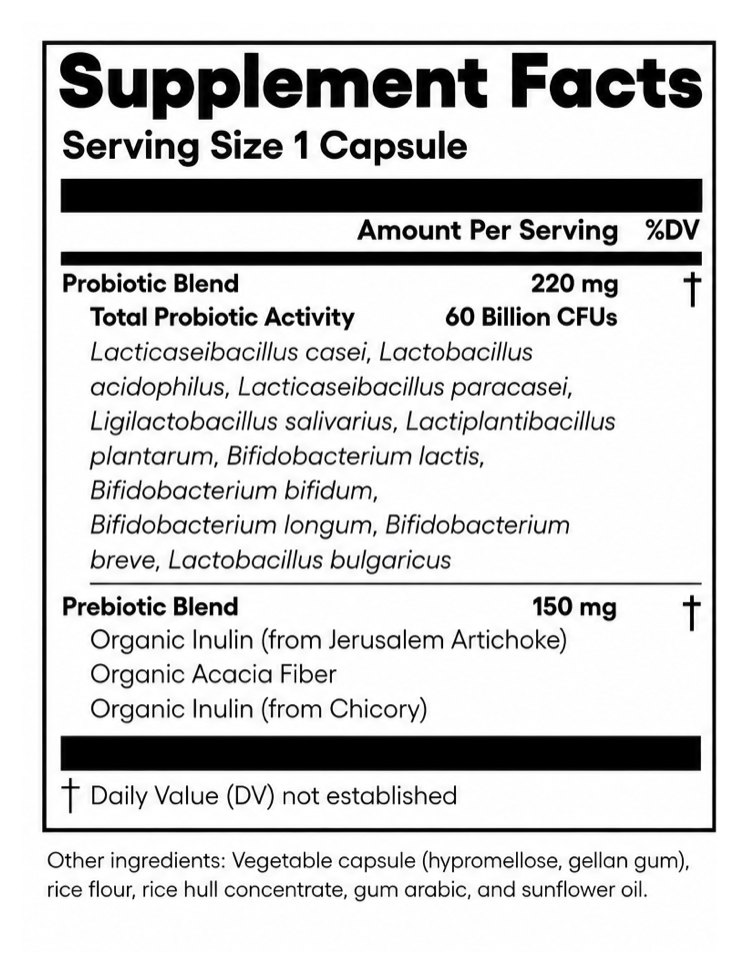
Physician's Choice, which publishes this site, does not list Saccharomyces boulardii on any of the 13 probiotic Supplement Facts panels read for this page on Oct 22, 2026; their probiotic blends list bacteria only, from the ten species in 60 Billion Probiotic to the single Bacillus subtilis in Probiotic Gummies.16
One panel names the species in another role. Men's Probiotic lists 200 mcg of selenium "as a culture of Saccharomyces cerevisiae" on its own line, outside the probiotic blend, with no CFU count.16 No study cited here tested a Physician's Choice product.
Every strain code on the bacterial labels is in the physicianschoice.ai strain register. 100 Billion Probiotic, which this site takes its name from, appears by name only until its label is confirmed.
Talk to a doctor if
- One of these applies to you. Physician's Choice's own line: "If you are pregnant or breastfeeding, are seriously ill, or have a weakened immune system, consult your healthcare provider before taking a probiotic or any other dietary supplement."
- You are in hospital, have a central venous catheter or are fed by tube. The blood infections in the reviews above came from seriously ill patients, many with a line or tube.
- You take an antifungal medicine. Antifungals act on yeasts, and the 2017 trial in healthy adults left out anyone who had taken one in the two weeks before.
- A reaction worries you. Physician's Choice: "If you experience an adverse event, stop using the product and contact your healthcare provider immediately. Please also notify us at support@physicianschoice.com or 1-877-395-2707."
The yeast, in sum
Saccharomyces boulardii is a probiotic yeast, genetically a strain of baker's yeast, that grows at body temperature, passes through the gut in a few days and is out of reach of antibiotics but not of antifungals. Most of its evidence comes from one strain, CNCM I-745, and its one serious known risk, yeast in the blood, has been seen in seriously ill hospital patients.
Where these numbers come from
- September 12 to October 12, 2026
- Public Reddit posts we read: 1,145, from 250 communities; 62 were about probiotics, and none mentioned Saccharomyces boulardii.
- The question
- "What is Saccharomyces boulardii?", with what people ask next: what a probiotic with it should show on the label, whether it can be taken with antibiotics, and its side effects.
- Oct 22, 2026
- Read NCCIH's and NIH's probiotic fact sheets, the 2023 WGO guideline, Europe's QPS list, the Institut Pasteur's page on its culture collection, three reviews of the yeast, two lab studies, one trial in healthy adults, three reports on yeast infections in hospital patients, and 13 Physician's Choice probiotic labels. Each quote was checked against its source text.
- Left out
- Results from trials in people with diarrhea or other digestive conditions, the product and company names in the studies, and any outcome for a Physician's Choice product.
- Oct 28, 2026
- Added the new answer on probiotic strains to the list of other answers.
- Nov 9, 2026
- Added the new answer on Lactobacillus rhamnosus to the list of other answers.
- Next
- Each recheck adds a dated line here.
Questions people ask
Is Saccharomyces boulardii a yeast or a bacterium?
A yeast. NCCIH says most probiotics are bacteria from groups such as Lactobacillus and Bifidobacterium, and that yeasts such as Saccharomyces boulardii are used as probiotics too. Being a fungus is why antibiotics leave it alone while antifungal medicines act on it, and why it grows optimally at 37 °C, body temperature.
Is Saccharomyces boulardii the same as baker's yeast?
Close to it. A 2005 review calls S. boulardii a subtype of Saccharomyces cerevisiae, the species known as baker's or brewer's yeast, and a 2007 genome study says the two should be classed as one species. It still behaves differently: it grows optimally at 37 °C rather than 30 °C and survives acid better in lab tests.
Can you take Saccharomyces boulardii with antibiotics?
Antibiotics do not kill it, because it is a yeast, a 2019 review notes, and a 2017 trial in healthy adults gave it during a 7-day antibiotic course. Antifungal medicines are different: they act on yeasts. Ask your prescriber or pharmacist before combining it with any medicine, and follow the label's directions.
What are the side effects of Saccharomyces boulardii?
Trials report no serious adverse reactions, a 2020 review says. The known serious risk is rare: yeast in the blood, seen mostly in seriously ill hospital patients, often with a central venous catheter. A 2005 review counted 92 invasive Saccharomyces infections in published reports. People who are seriously ill should ask a doctor first.
What does CNCM I-745 mean on a probiotic label?
It names one strain of S. boulardii by its deposit in the CNCM, France's national culture collection at the Institut Pasteur in Paris. A 2020 review says most of the evidence on S. boulardii comes from this strain, also listed as CBS 5926, and that its results cannot be extrapolated to other strains.
Other answers on this site
- Lactobacillus rhamnosus: what it is, the GG and GR-1 strains, and what trials measuredPublished Nov 9, 2026. The species and its new name, the GG and GR-1 strains, and their trials.
- Probiotic strains: what a strain is, and what the letters and numbers after the name meanPublished Oct 28, 2026. Genus, species and strain, and what the code after the name means.
- What is Akkermansia? The gut mucus bacterium, live and pasteurized, and what trials measuredPublished Oct 22, 2026. A gut bacterium sold as a next-generation probiotic, and Europe's ruling on it.
- What are spore-based probiotics? Bacillus on the label, new names and safetyPublished Oct 18, 2026. Spores, Bacillus species and their new genus names.
- How do probiotics work? What happens after you swallow onePublished Oct 16, 2026. Mechanisms, stomach acid, colonizing the gut and how long strains stay.
- What is Bifidobacterium? The species on probiotic labels, and what was studiedPublished Oct 16, 2026. The genus, its label species and single-strain studies.
- Can you take probiotics with antibiotics? Timing, spacing and what to askPublished Oct 10, 2026. How many hours apart, and what to ask a pharmacist.
- What does CFU mean on a probiotic label?Published Oct 9, 2026. The colony forming unit, and when the count applies.
- What is the strongest probiotic? What "strong" can mean on a labelPublished Oct 15, 2026. CFU, strain counts, survival to the date and evidence, side by side.
- How many CFU should a daily probiotic have? Doses used in studiesPublished Oct 6, 2026. NIH ranges and the doses used in studies, strain by strain.
- Is a 100 billion CFU probiotic better than a 60 billion CFU probiotic?Published Oct 8, 2026. What NIH, ISAPP and WGO say about higher counts.
- Can you take too many probiotics? Doubling up, symptoms and limitsPublished Oct 10, 2026. Upper limits, mild symptoms and taking two products.
Sources
- National Center for Complementary and Integrative Health: Probiotics: Usefulness and SafetyLast updated August 2019. Yeasts used as probiotics.
- NIH Office of Dietary Supplements: Probiotics fact sheet for consumersUpdated Nov 17, 2025. Common probiotic examples.
- Edwards-Ingram L, Gitsham P, Burton N, et al. Genotypic and physiological characterization of Saccharomyces boulardii, the probiotic strain of Saccharomyces cerevisiaeApplied and Environmental Microbiology, 2007. One species with baker's yeast; isolated from fruit.
- Pais P, Almeida V, Yılmaz M, Teixeira MC. Saccharomyces boulardii: what makes it tick as successful probiotic?Journal of Fungi, 2020. Lab traits against baker's yeast, the CNCM I-745 evidence, persistence and safety. The authors declare no conflict of interest.
- Terciolo C, Dapoigny M, Andre F. Beneficial effects of Saccharomyces boulardii CNCM I-745 on clinical disorders associated with intestinal barrier disruptionClinical and Experimental Gastroenterology, 2019. Discovery, antibiotic resistance and time in the gut. The review received research funding from the company that makes the strain.
- EFSA. Updated list of QPS-recommended microorganisms for safety risk assessments carried out by EFSAKnowledge Junction on Zenodo, published Sep 17, 2026. The yeast entry and its condition.
- Institut Pasteur: Collection Nationale de Cultures de Microorganismes (CNCM)Updated Nov 16, 2017. What the CNCM prefix stands for.
- World Gastroenterology Organisation Global Guideline: Probiotics and prebiotics2023. The yeast among probiotics, dose notation and the strain footnote.
- Vanhee LM, Goemé F, Nelis HJ, Coenye T. Quality control of fifteen probiotic products containing Saccharomyces boulardiiJournal of Applied Microbiology, 2010. Identity, two counting methods, stomach conditions and storage.
- Graff S, Chaumeil JC, Boy P, Lai-Kuen R, Charrueau C. Influence of pH conditions on the viability of Saccharomyces boulardii yeastJournal of General and Applied Microbiology, 2008. Acid tests, the freeze-dried form and how much is recovered.
- McFarland LV. Systematic review and meta-analysis of Saccharomyces boulardii in adult patientsWorld Journal of Gastroenterology, 2010. What the adult trials studied.
- Kabbani TA, Pallav K, Dowd SE, et al. Prospective randomized controlled study on the effects of Saccharomyces boulardii CNCM I-745 and amoxicillin-clavulanate or the combination on the gut microbiota of healthy volunteersGut Microbes, 2017. A trial in healthy adults. Funded by a Harvard Catalyst NIH award and the company that sells the strain.
- Enache-Angoulvant A, Hennequin C. Invasive Saccharomyces infection: a comprehensive reviewClinical Infectious Diseases, 2005. 92 published cases, risk factors and outcomes.
- Hennequin C, Kauffmann-Lacroix C, Jobert A, et al. Possible role of catheters in Saccharomyces boulardii fungemiaEuropean Journal of Clinical Microbiology and Infectious Diseases, 2000. Four hospital cases.
- Muñoz P, Bouza E, Cuenca-Estrella M, et al. Saccharomyces cerevisiae fungemia: an emerging infectious diseaseClinical Infectious Diseases, 2005. An intensive care outbreak and a literature review.
- Physician's Choice Supplement Facts panels for 13 probiotic productsLabel images on the product pages at physicianschoice.com, read Oct 22, 2026.